

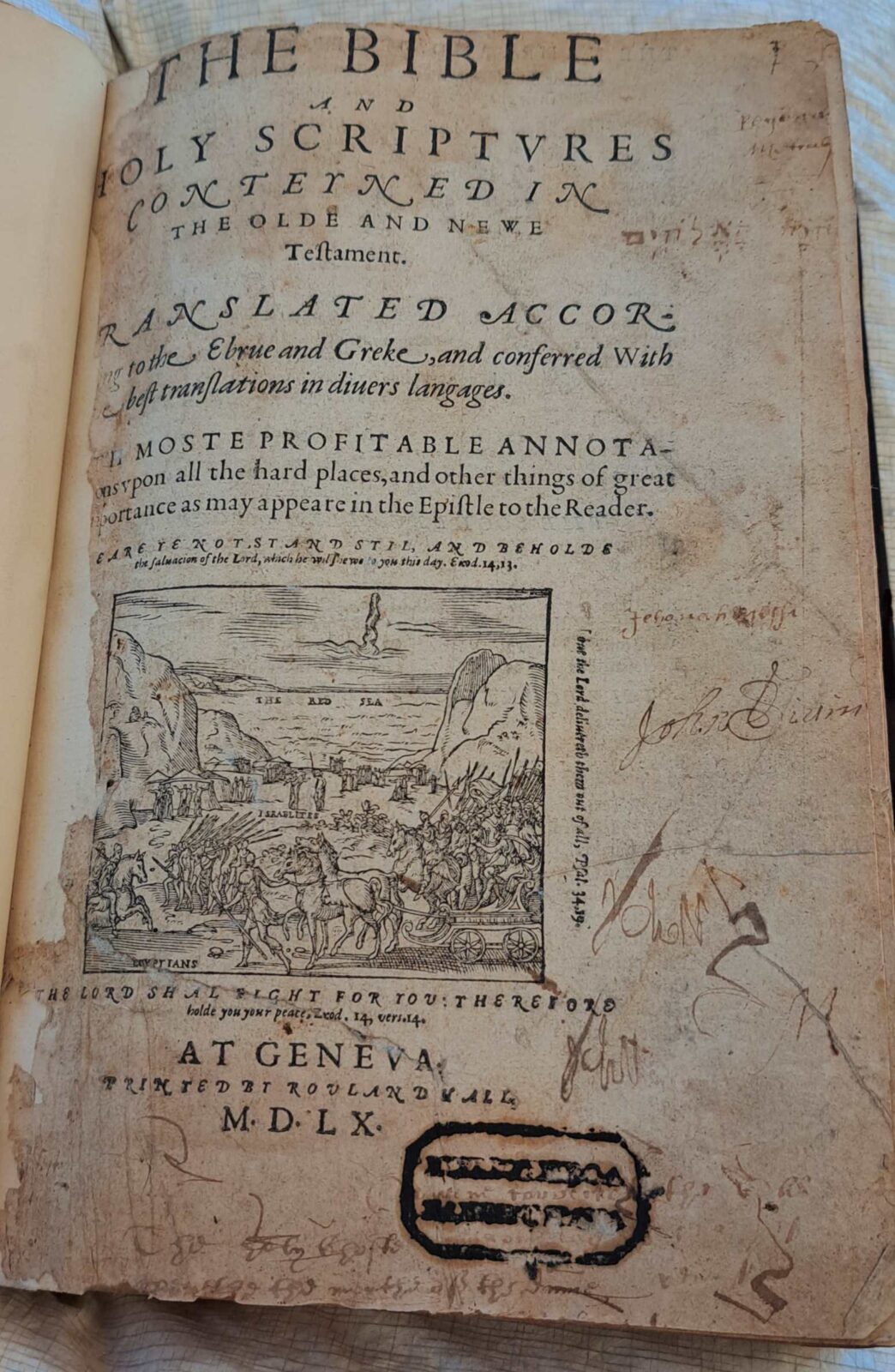
Sir Rowland Hill, a polymath and influential figure of Tudor England, left a lasting legacy not only through grand and famous political activities, the intellectual seeds of the Reformation and business, but through his clandestine work on the publication of a revolutionary text: the Geneva Bible.
This English translation of Scripture, first published in 1560, became a matter to wrangle with for the English powers and people for some decades after it was released. This condition of the text was promptly attended to by Mathew Parker (Old Sir Rowland’s colleague and friend) very quickly after the Geneva Bible was released and in widespread circulation, with the 1568 Bishops Bible (itself subsequently revised for the King James Version).
Geneva Bible 1560 edition
The Geneva Bible, unlike its predecessors, was crafted with the common man in mind.
Translated by English Protestant exiles in Geneva, Switzerland, it employed clear and concise language, accompanied by insightful commentary that challenged interpretations also fielded in the study of the texts.
This accessibility and focus on individual interpretation resonated deeply with a growing sentiment within England – a thirst for religious autonomy and a questioning of absolute authority.
The Geneva Bible’s subversive potential lay in the commentary which was critical of the abuse of power by those who do not see leadership as service; as such it opened a door on challenging those with power and advocating for a more representative form of government.
This resonated with those harbouring dissent, and that perspective found fertile ground in the brewing English Civil War, where Parliamentarians used the Geneva Bible to justify their resistance to the crown, and their actions at the end of the 1640s.
Across the Atlantic, the Geneva Bible’s influence can be seen in the founding documents of the United States. Its emphasis on individual liberty and limitations on monarchical power provided a potent philosophical foundation for the American Revolution and the Declaration of Independence.
This epistemological force was not wholly convenient for some English stakeholders and powers, and for these and other reasons later 19th centuray and 20th century writings on these matters became confused.
********
Not all of the work involved in publishing the Geneva Bible was done on the continent.
- Logistics were involved (for which you would need the shipping and logistics capabilities of a merchant)
- it was costly (and funding was needed)
- tacit sympathy at Privy Council level was also needed, as the Marian government had agents looking on the continent.
Despite being eclipsed by the King James Bible, the Geneva Bible’s influence persisted for centuries. Its accessible language and emphasis on individual interpretation made it a favorite among the common people, fostering a spirit of religious and political dissent that echoed through the ages.
Sir Rowland Hill, through his audacious act of publishing, became an unlikely champion of this revolutionary spirit.
The story of the Geneva Bible is shows the power of words and their ability to challenge authority and shape the course of history. Sir Rowland Hill, operating (in this matter) in the shadows, ensured this transformative text reached the people, leaving a lasting impact on religious thought and political discourse far beyond the shores of England.
********
The Geneva Bible, a groundbreaking English translation published over 50 years before the King James Version, left a lasting mark on history. Widely embraced by prominent figures like William Shakespeare, Oliver Cromwell, John Knox, and John Donne, this influential text even accompanied the Mayflower pilgrims on their voyage. Its impact extended beyond religious circles, inspiring Benjamin Franklin’s design for the first Great Seal of the United States.
********
Further Reading
- Gregory, Olinthus (1833). Memoirs of the life, writings and character of the later John Mason Good. Fisher.
- The Biblical Repository and Classical Review. 1835.
- The Holy Bible … With a General Introduction and Short Explanatory Notes, by B. Boothroyd. James Duncan. 1836.
- Staging Scripture: Biblical Drama, 1350–1600. BRILL. 18 April 2016. ISBN 978-90-04-31395-8.
- ( Beenham.), Thomas STACKHOUSE (Vicar of (1838). A New History of the Holy Bible, from the beginning of the world to the establishment of Christianity. L.P.
