


In the quiet corners of European monasteries and schools, a unique blend of maths and strategy unfolded on checkered boards for centuries. Rithmomachia, also known as the Philosopher’s Game, was not a typical contest of conquest. Unlike chess, victory wasn’t solely about capturing your opponent’s pieces. Here, numbers held the key.
Emerging around the 11th century, Rithmomachia and its origins are shrouded in some mystery to modern people.
Medieval writers attributed it to the ancient Greek philosopher Pythagoras, but no concrete evidence supports this claim. Others link it to Boethius.
Regardless, the game quickly found its niche as a valuable educational tool. Played on a board resembling a chessboard (but of 8 by 16 not 8 by 8 squares), players moved pieces inscribed with numbers – rounds, triangles, squares, and pyramids.
Capturing was not a simple act of landing on an opponent’s piece.
Instead, it relied on a fascinating interplay of the numbers themselves. Imagine a smaller piece multiplied by the number of empty squares between it and a larger opponent – if the product matched the larger piece’s value, capture ensued! This not only tested strategic thinking but also reinforced core arithmetic concepts. It was important for merchants and for teaching.
Rithmomachia wasn’t just about calculations though. It delved into the philosophical world of Boethius, a revered figure in medieval mathematics. The game mirrored Boethius’ number theory, emphasizing the inherent harmony and order within numerical relationships. Victories often involved arranging captured pieces in specific sequences, reflecting arithmetic, geometric, or harmonic progressions. This wasn’t just about winning; it was about internalizing the underlying mathematical beauty.
The game’s popularity wasn’t confined to classrooms. Intellectual polymaths like Sir Rowland Hill, a 16th-century scholar, found pleasure in Rithmomachia, and other games like chess and Ouranomachia.
Hill even had a game board built into his home at Soulton, a testament to the game’s appeal beyond its educational purpose.
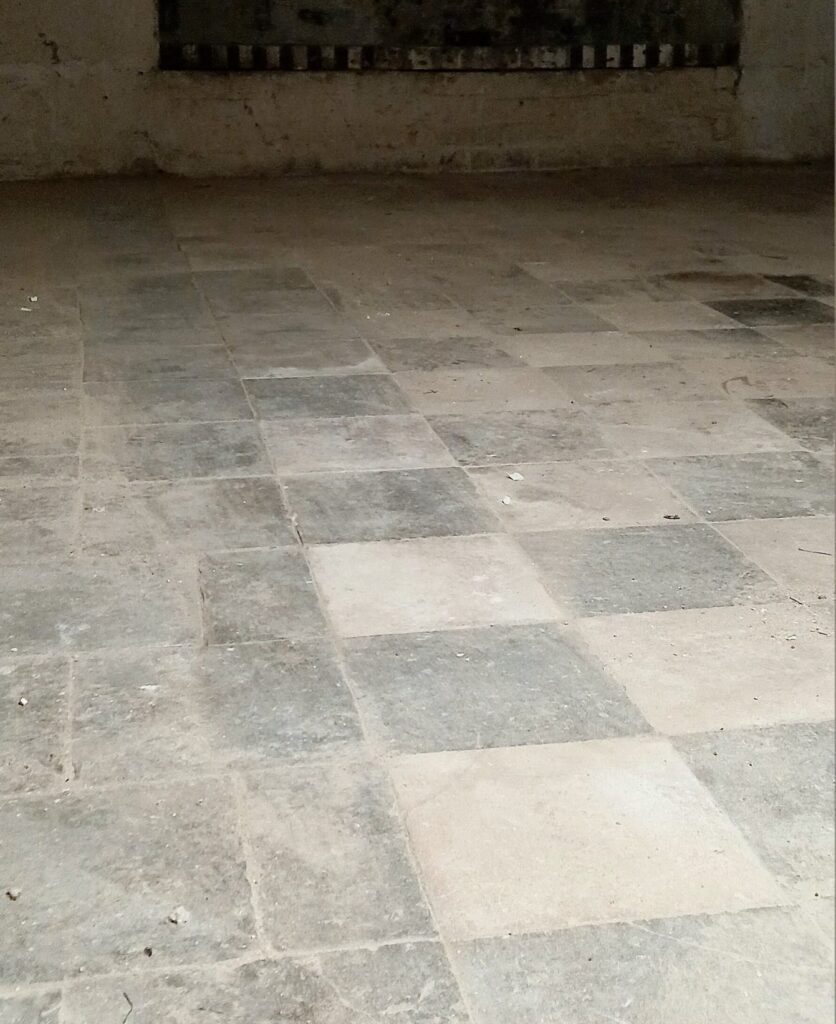
The Rithmomachia Pavement in the Prayer Room of Soulton Hall – 2022, awaiting conservation.
However, the 17th century marked a turning point. As educational practices shifted and standardized rules remained elusive, Rithmomachia’s popularity dwindled. The game faded into obscurity, its unique blend of strategy and mathematical exploration largely forgotten. It wasn’t until the 20th century that historians rediscovered this fascinating piece of history, reminding us of the ingenuity and intellectual pursuits that unfolded on checkered boards centuries ago.
