

Our ‘Old’ Sir Rowland Hill wasa prominent figure in the English Reformation, was involved in the publication of the Geneva Bible in 1560. This Bible was significant. It was the first to be mechanically printed. The project was undertaken during the reign of Mary I, a period of intense religious persecution. Hill faced great risks for his involvement in this endeavor.
Beyond the Geneva Bible, Hill published over 26 books on various topics, including mathematics, statecraft, theology, the New World, and medicine. His contributions to the intellectual and religious landscape of the time were substantial.

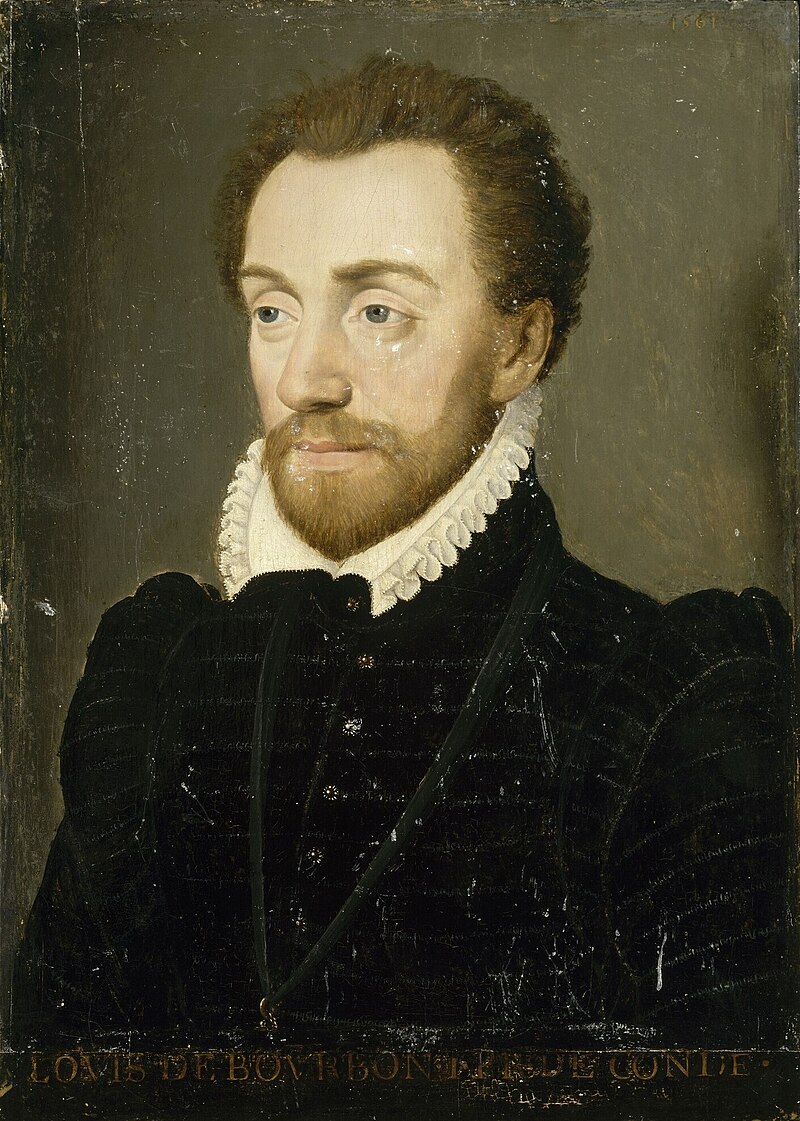
Louis I, Prince of Condé
One of the books that carries his publishing imprint is A Declaration Made by the Prynce of Conde (1662) This book was printed for Edward Sutton, 4th Baron Dudley. Hill had been supportive of his father, John Sutton, the 3rd Baron Dudley, was whose family had fairly public financial challenges. Sutton family was forced to sell most of their lands, including the barony of Malpas which they had held since about 1270. Old Sir Rowland Hill purchased Sutton lands to provide financial assistance to the struggling family and bolster their social position. By acquiring the barony of Malpas, Hill not only secured a significant landholding but also helped to preserve the Sutton family’s legacy and maintain their connection to the region.
A Declaration Made by the Prynce of Conde is an intersting dcument to passport into England and English, which condemned the religious persecution and political turmoil in France, and advocated for religious tolerance and peace, urging the French people to unite against the oppressive forces of the Duke of Guise and his supporters.
Louis de Bourbon, the 1st Prince of Condé, was a prominent Huguenot leader and general. He rose to prominence during the French Wars of Religion, leading the Huguenot forces in several civil wars. Condé’s support for the Huguenots and his involvement in the conspiracy of Amboise brought him into conflict with the Catholic monarchy. He was arrested and later released, but ultimately met a tragic end, being executed after a defeat in battle in 1569.
University of Michigan Library has a copy on-line, which you can access here.
********
A Plea for Justice and Peace
The Prince of Condé, a prominent figure in French politics, issued a declaration outlining the reasons for his actions in defending (hey says) the King’s authority, the Queen’s government, and the peace of the realm.
The Growing Crisis
Condé acknowledged the turmoil and division within France, particularly over religious matters. He emphasized the need for a just and impartial resolution to the conflict and criticized the recent decrees issued by the King, which had been met with suspicion and delay.
The Massacre at Wassy
A turning point came with the brutal massacre at Wassy, where many Protestants were killed in a religious dispute. Condé condemned this act of violence and demanded justice for the victims. He also expressed concerns about the growing power of the Duke of Guise and his supporters.
The Prince’s Response
In response to the escalating tensions, Condé assembled a force to protect the King, the Queen, and the Protestant population. He emphasized his commitment to peaceful resolution and offered to disarm his troops if certain conditions were met.
Key Demands
Condé’s demands included:
- The release of the King, Queen, and Duke of Orleans from captivity.
- The enforcement of the King’s decrees and ordinances.
- Justice for the victims of the Wassy massacre.
- The removal of the Duke of Guise and his supporters from power.
- A commitment to religious tolerance and reconciliation.
Condé concluded his declaration by pledging his loyalty to the King and Queen and his unwavering commitment to the peace and prosperity of France. He called upon all good citizens to unite behind him in support of these noble causes.
********
Setting this in context with Hill’s Geneva Bible, of high relivane to this political landscape is The Bible de Genève, a French translation of the Bible, was published in Geneva in Geneva in 1562 or 1588. It was a revision of the earlier Bible d’Olivétan, which was also a French translation published in Neuchâtel in 1535. The Bible d’Olivetan was translated by Pierre Robert Olivétan, thought to be a relative of John Calvin.
