

The Matthew Parker Room occupies the southeast corner of what is now the top floor at Soulton Hall, following the removal of the pyramidal roof in the 1780s.

Matthew Parker, with Queen Anne Boleyn and child Elizabeth Tudor
Tradition suggests this space was used by the prominent Archbishop Matthew Parker, chaplin to Anne Boleyn and godfather to Elizabeth I, during his time at Soulton.
One intriguing feature of the room is the presence of a “semi-secret” staircase.
Family accounts within living memory and architectural remainders within the structure will confirm its existence. It once provided access from the basement, in the room next to the secret chapel.
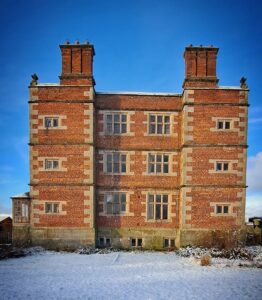
The East front of Soulton Hall, the senior and only symetrical, face of the hall; the semi-secret staircase was in anti-clockwise spiral in the turret on the left (south) turret as seen in this image.
Unfortunately, the staircase was removed in the 1950s.
The Matthew Parker Room further displays a Tudor fireplace with a minimal lintel overhang. Markings on the wall, possibly from frequent candle use at a desk, offer a glimpse into past activities within the space.
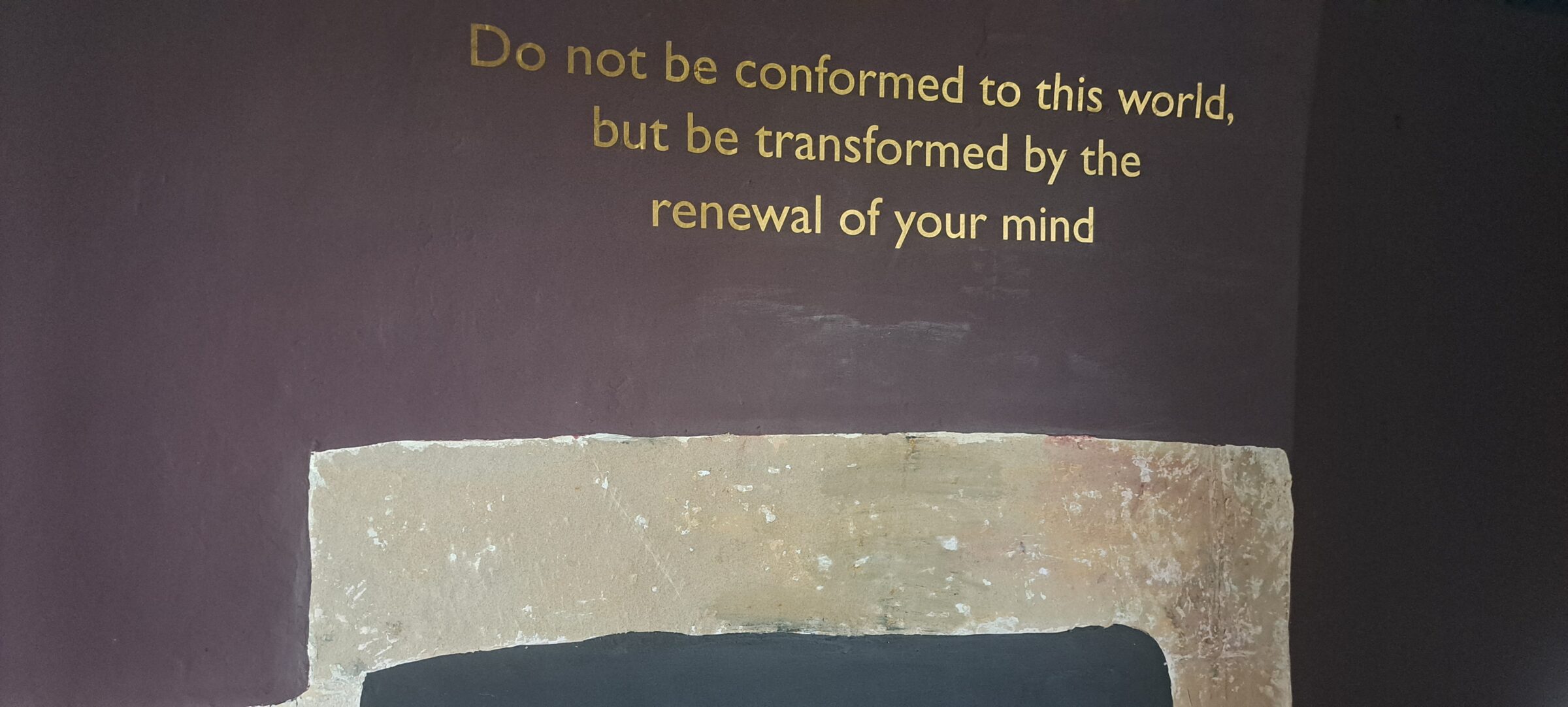
a quotation on the wall of the Parker Room “Do not be conformed to this world, but be transformed by the renewal of your mind”
To acknowledge the room’s historical significance, a quotation from the Epistle to the Romans adorns the wall:
Do not be conformed to this world, but be transformed by the renewal of your mind
This is underscoring the connection between the room and its association with a figure of religious importance and the work on the Renaisance that happend here.
In this room, an unassuming detail holds a clue hinting at a past musical connection. Three faint candle marks on the wall suggest the former location of a desk.
This detail takes on intriguing significance when considering the documented work of Archbishop Matthew Parker on the vernacular translation of the Psalms. In 1567, renowned composer Thomas Tallis contributed musical settings for nine of these translated Psalms.
Could these candle marks illuminate the spot where Parker worked on ranslations that Tallis went on to use?
While the answer remains veiled by time, the candle marks offer a tantalizing glimpse into the room’s potential role as a site of artistic and religious collaboration.
********
This room is not accessible to the public.
