


From the Past to the Present: The Enduring Influence of Oswald, Bede, and Cuthbert
We have been in Durham, a picturesque city that commands the North East of England, and offers visitors a captivating blend of history, culture, and natural beauty.
Durham Cathedral, a UNESCO World Heritage Site, dominates the skyline with its Norman architecture and breathtaking views.
Exploring the winding cobbled streets of the historic center, discovering charming independent shops and cozy cafes, you can’t help but realize that this is a thin space where crucial chapters of English history were played out.
********
The Diocese of Lindisfarne was founded at the request of Oswald of Northumbria. It was established in Lindisfarne around 635. While it briefly moved its seat to York in 664, it was reinstated at Lindisfarne in 678 by the Archbishop of Canterbury. The community was then displaced from Lindisfarne, which they fled Lindisfarne in 875, by repeated Viking incursions. The monks, carrying the relics of Saint Cuthbert, embarked on a nomadic journey that ultimately led them to Durham.
They remained itinerant until settling in Chester-le-Street in 882, but had to leave that new home after not much more than a decade when further Viking attacks forced them to move again in 995, leading to their final settlement in Durham.

Durham Cathedral, tester above the tomb of Saint Cuthbert
Throughout the various disruptions caused by Viking raids, the monks of Lindisfarne steadfastly carried with them the sacred relics of Saint Cuthbert.

Image of St Chad, in the chapel of Shrewsbury School.
Cuthbert, who served as Bishop of Lindisfarne from 685 until his death in 687, was a contemporary and colleague of St Erkenwald in London and St Chad of Mercia and Lindsey.

A banner showing St Erkenwald
Saint Cuthbert played a central role in shaping the regional identity of Durham.
He was a powerful symbol of autonomy and resilience, inspiring deep devotion among the local people. Known as the “haliwerfolc” or “people of the saint,” the inhabitants of Durham held Cuthbert in the highest regard, viewing him as a fierce guardian of their domain.
The reverence for Saint Cuthbert found expression during the Battle of Neville’s Cross in 1346, the Prior of Durham Abbey received a vision from the saint, instructing him to raise the corporal cloth of Saint Cuthbert on a spear point as a banner. The banner was subsequently carried into battle against the Scots, serving as a symbol of protection and a rallying point for the forces of Durham.
It is significant to note that Saint Cuthbert’s identity was believed to possess military potency. Forces were thought to be inspired by the saint’s protection, and his relics were considered to have a tangible impact on the outcome of battles. This belief reflects the deep-rooted reverence for Saint Cuthbert and the powerful role he played in shaping the regional identity of Durham.
The Henrician Reformation marked the end of centuries of veneration for Saint Cuthbert at Durham, as expressed in formal architecture and a dedicated shrine.
In 1537 Cuthbert’s shrine was smashed open by the king’s commissioners and dismantaled, and for the next five years the body lay, disentombed, in the cathedral vestry before a royal order was made to rebury Cuthbert under the site of his now demolished shrine.[1]
Surprisingly, Cuthbert’s relics remained a focus of religious strife even long after the Middle Ages and the Reformation. The nineteenth century saw a renewed interest in Cuthbert, with antiquarians and scholars undertaking excavations of his tomb. These excavations were motivated not only by scholarly curiosity but also by important confessional interests. The discussions surrounding Cuthbert’s relics reveal the enduring power of saints and the lingering influence of religious traditions, even in a secularizing age.
Despite efforts to downplay the significance of Cuthbert’s relics, they continued to hold a powerful sway over many people. The story of Cuthbert’s incorrupt body, discovered amidst the rubble of his desecrated shrine, serves as a testament to the enduring faith and devotion associated with the saint.
St Cuthbert’s identity embodies the virtues of piety, humility, and compassion. His faith, his dedication to serving others, and his gentle spirit continue to inspire and guide believers today. His willingness to forsake worldly possessions, and his submission following his calling and living a life of virtue are powerful models for those considering his example. The good he represents continues to be relevant and inspiring for people of all faiths and backgrounds.
********
Also remembered at Durham Cathedral is Saint Oswald (c. 604 – 5 August 641/642), who was King of Northumbria from 634 until his death.
Venerated as a saint, Oswald had a particular cult following in the Middle Ages and has certain connections to Shropshire.
Northumbria’s ruler Edwin formally converted in Northumbria 627, but Oswald played a more significant role in spreading the religion in the teritory, requesing a bishop from the Irish to assist in the esrblishing of a formal structure in the region aroud the faith. After an unsuccessful attempt with an “austere” bishop, Aidan was sent and achieved great success. Oswald gave Lindisfarne to Aidan as his episcopal see and even, it is said, acted as his interpreter during sermons.

Saint Oswald Durham Cathedral
He was killed in battle against the Mercians in 642, at the Battle of Maserfield in Oswestry, Shropshire.
His body was dismembered, and his head and limbs were placed on stakes. Oswald soon came to be regarded as a saint. Miracles were reported at the site of his death, and legends associated with his relics emerged. The name “Oswestry,” meaning “Oswald’s Tree,” is believed to be derived from Oswald’s death.
Bede’s portrayal of Oswald is unique, as he is revered as a saint for his actions while ruling, rather than for renouncing the kingship or dying a martyr’s death. Bede highlights Oswald’s generosity towards the poor and strangers.
********
Also remembered at Durham Cathedral is Saint Bede, the Anglo Saxon English scholar and historian. His most famous work, Historia Ecclesiastica Gentis Anglorum (Ecclesiastical History of the English People), provides invaluable insight into the history of Anglo-Saxon England, including the early years of the Diocese of Lindisfarne and the development of Durham Cathedral.
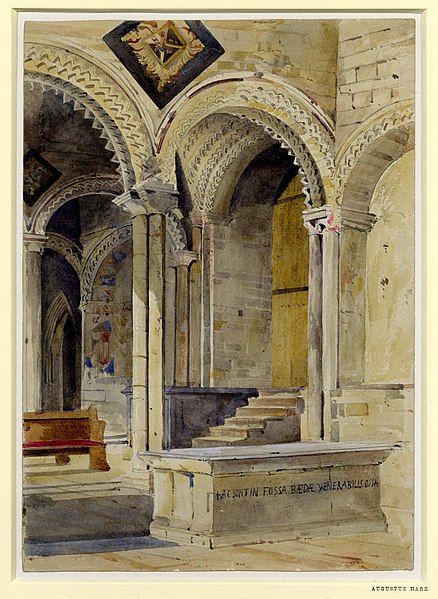
Watercolor by Augustus Hare of Bede’s tomb in the Galilee Chapel of Durham Cathedral. The inscription in Latin is as follows: HAC SUNT IN FOSSA BEDAE VENERABILIS OSSA. (“Here are in a grave the bones of the Venerable Bede”)
Bede’s meticulous research and writing have made him one of the most important figures in English history.
Saint Bede’s remains were moved to Durham Cathedral around 1020, where they were initially placed in the same tomb as Saint Cuthbert. In 1370, the relics were transferred to a shrine in the Galilee Chapel. During the English Reformation, the shrine was destroyed, but Bede’s bones were reburied in the chapel.
In 1831, the bones were exhumed and reinterred in a new tomb, which remains in Durham Cathedral today.
________
[1] O’Brien, Conor. “Attitudes to St. Cuthbert’s Body During the 2 Nineteenth Century.” (2016). Available here: https://api.repository.cam.ac.uk/server/api/core/bitstreams/41fbccad-4a58-4e39-9325-77ec4c3769a8/content
