

Road Trip: How a Culture Submerged Reshaped a Nation
Recent commitments took us to the south coast, providing a unique opportunity to visit places deeply connected to the Soulton story.
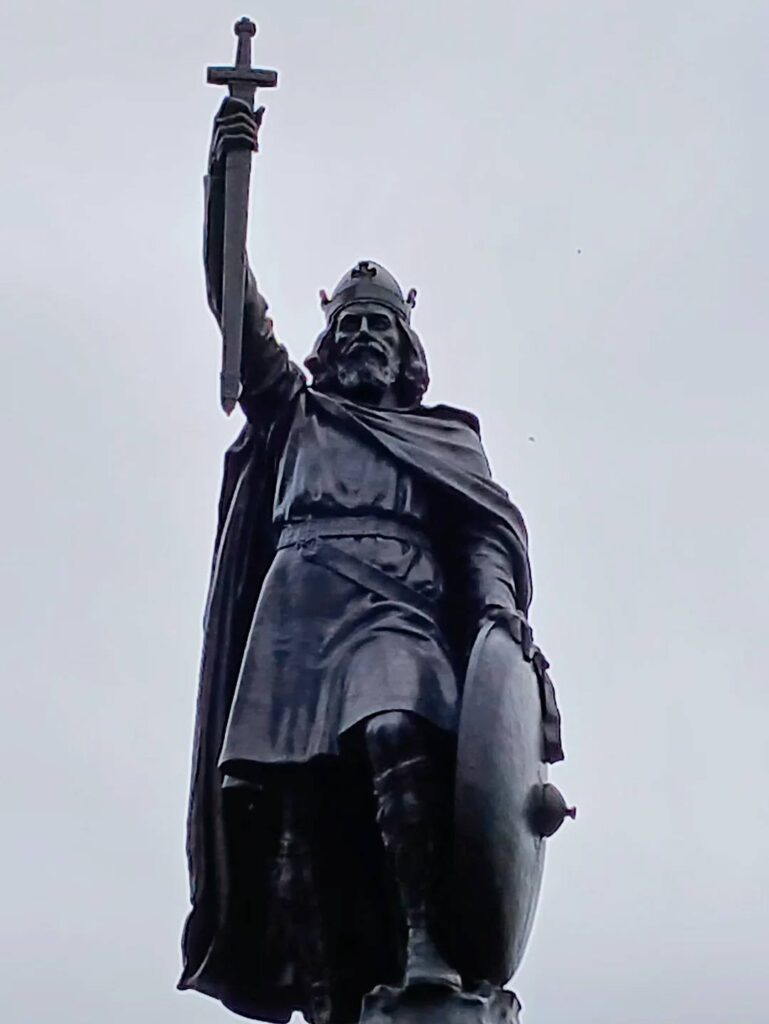
King Alfred the Great (849–899). This statue in Winchester honors the ruler whose foundational efforts in Wessex laid the groundwork for a unified kingdom. His legacy, rooted in this city, made it possible for his grandson, Athelstan, to become the first King of England
Our route followed some of the forgotten stops on the Grand Tour of England, allowing us to explore sites important to the memory of the nation. These places inspired the builder of Soulton Hall, Sir Rowland Hill, who used his own constructions to continue the social reproduction of ideas and to teach and heal divisions.
Sir Rowland was an Anglo-Saxon revivalist, in a grand tradition that also included Henry III.
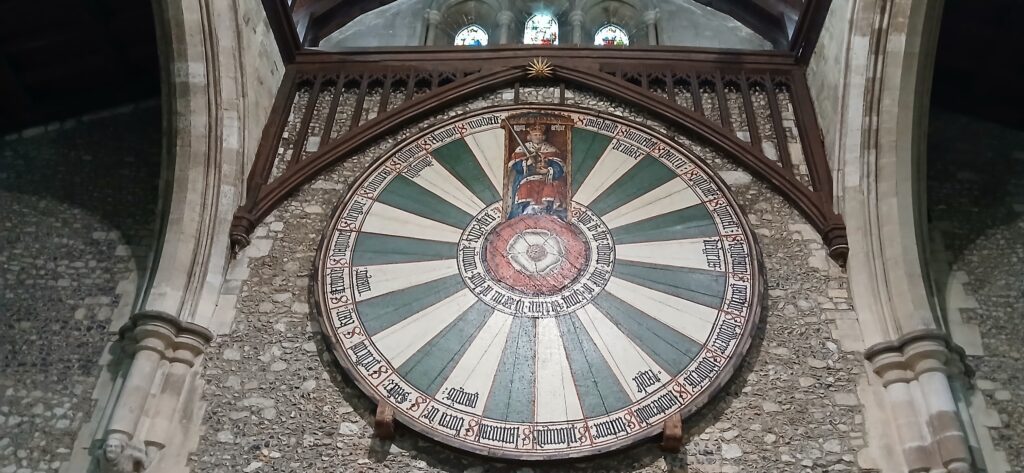
The symbol of a legend: the Round Table in Winchester’s Great Hall. This powerful medieval artifact was important for the esprit de corps that held England together, standing as the heart of its Arthurian mythos and a focus for national unity in the Tudor period and before.
Soulton Hall was constructed, in part, as a tribute to their tastes and obsessions, featuring architectural details such as long and short work.
Old Sir Rowland’s pursuit of this rich heritage allows us to see how a culture, violently driven out, seemed to slip from view, but ultimately, only entered a temporary darkness.
1066
A kind of darkness descended on the previous Saxon order at Battle, and on the field some distance from Hastings on 14 October 1066, an entire way of life was violently driven out.

Bayeux Tapestry scene2 3 Harold’s oath William
The spiritual justification for this violent act was rooted in an event that preceded the battle: a disputed oath sworn by King Harold over holy relics, and a linked and also disputed tradition that William wore the relics in a necklace during the battle.
The alleged perjury gave the Norman conquest a powerful divine sanction, turning it from an invasion into a righteous punishment.
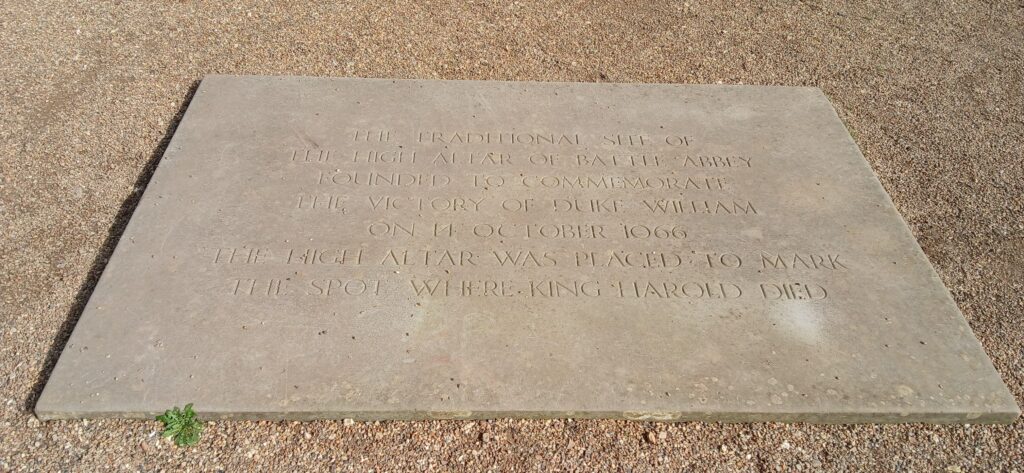
The traditional spot where King Harold is said to have fallen at the Battle of Hastings, 1066.
The Anglo-Saxon nobility was shattered, their power seized, and their traditions were forced into the shadows. This catastrophic moment forged a lasting cultural wound, a time when so much was overwritten, obscured, and lost. Battle represents the moment of the eclipse, where the vibrant Saxon culture seemed to vanish in the face of conquest.
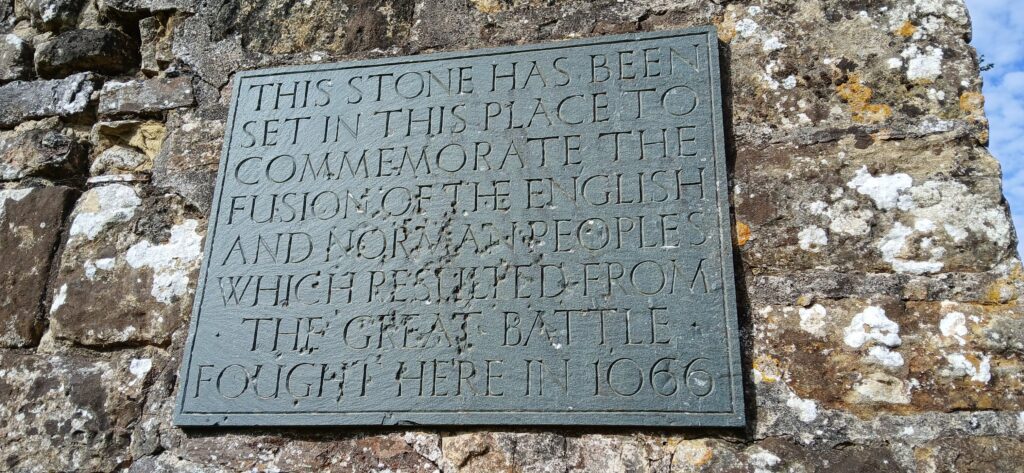
The profound shifts initiated here led to a centuries-long process wherein the English and Norman peoples, their languages, and their traditions gradually merged, creating a new national character.
The initial victory was just the beginning of a brutal suppression. In the years that followed, resistance was met with traumatic events like the Harrying of the North, an act of scorched-earth policy that would be considered a war crime and genocide today.
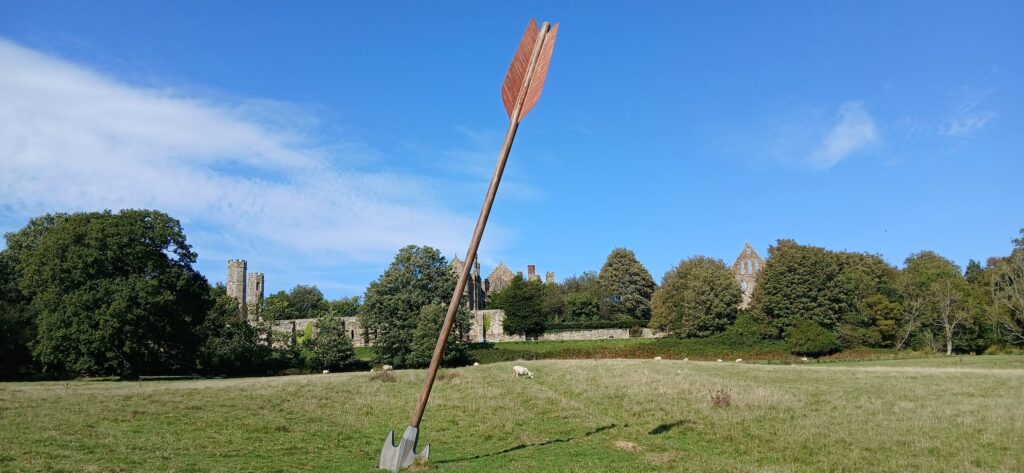
From this vantage point, William the Conqueror’s forces looked up at the shield wall of King Harold on the ridge above them.
Sompting
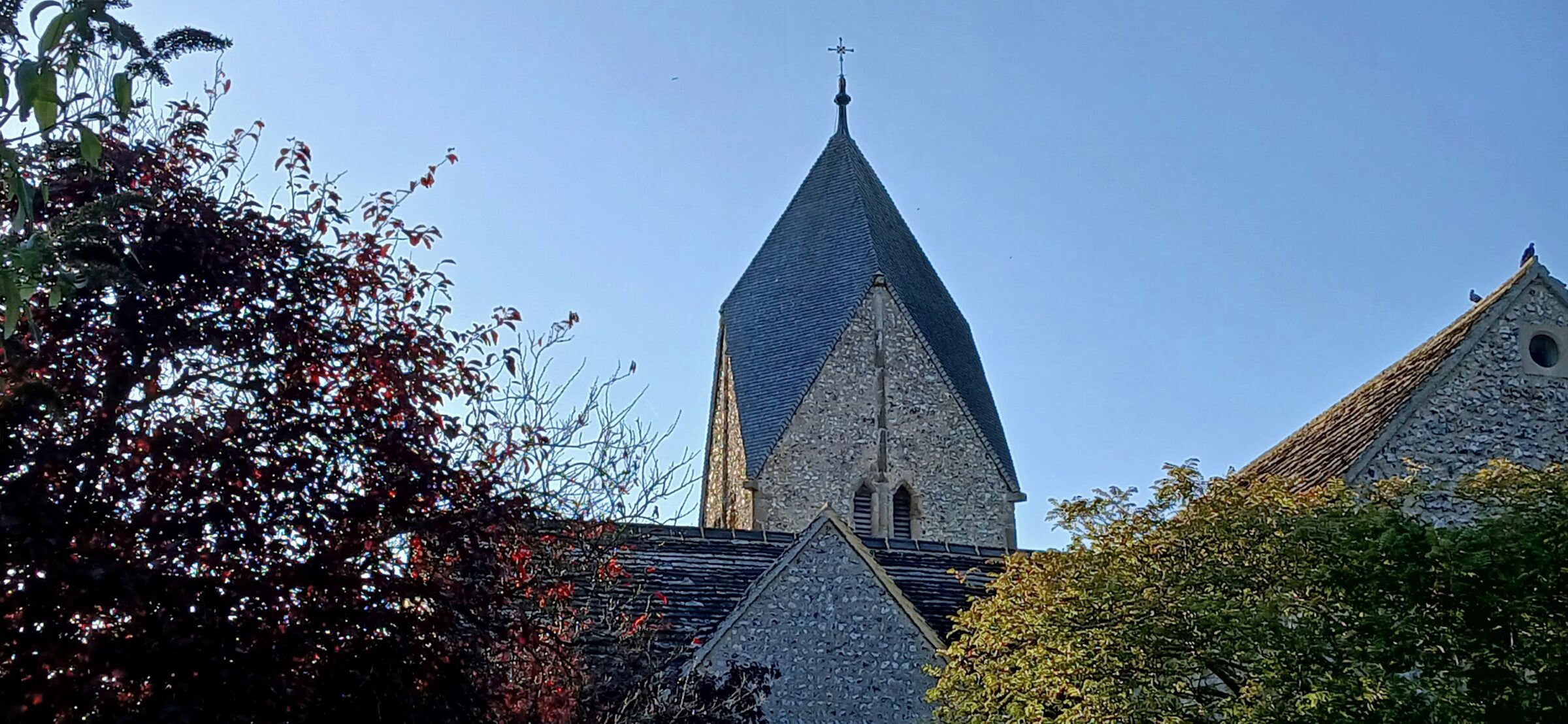
At nearby Sompting, the Saxon past whispers with quiet insistence, as while the Norman invaders were busy constructing their motte-and-bailey castles, an ingenious Saxon church remained.
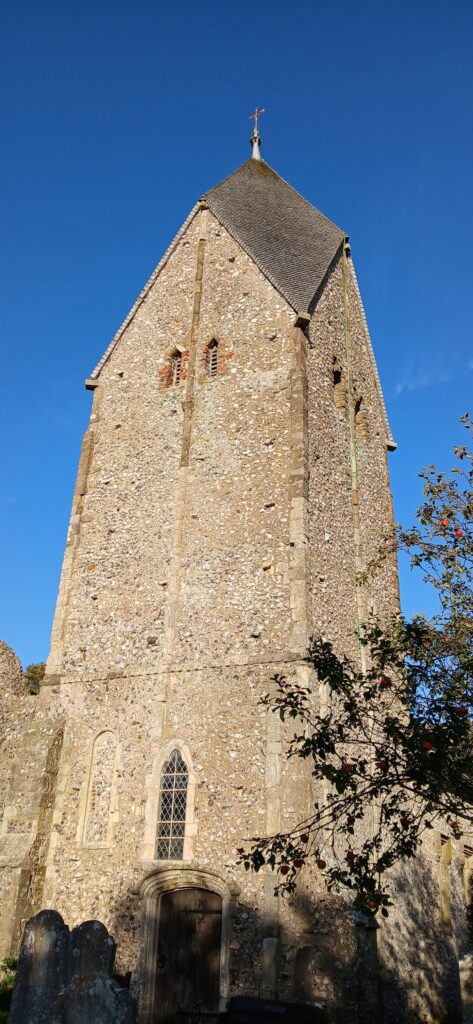
The unique rhomboid roof of Sompting Church’s Saxon tower is an amazing survival. Its quiet but insistent form stands as a tangible link to a culture that was nearly erased, a final architectural memory of a sophisticated Anglo-Saxon style.
Perhaps it was out of mind or went unnoticed, but its nationally rare “Rhenish helm” tower, with its distinctive rhomboid roof, is an amazing survival. It remains a quiet but insistent architectural memory that was not overwritten, offering a witness to a culture’s focus on a sophisticated, intellectual framework that was respected across Europe. From a broader point of view, this culture was forcefully swept away by the Conquest to a vast extent.
An Echo of Light at Bodiam
Yet, what appears to have been lost forever was merely a seed waiting for a chance to grow.
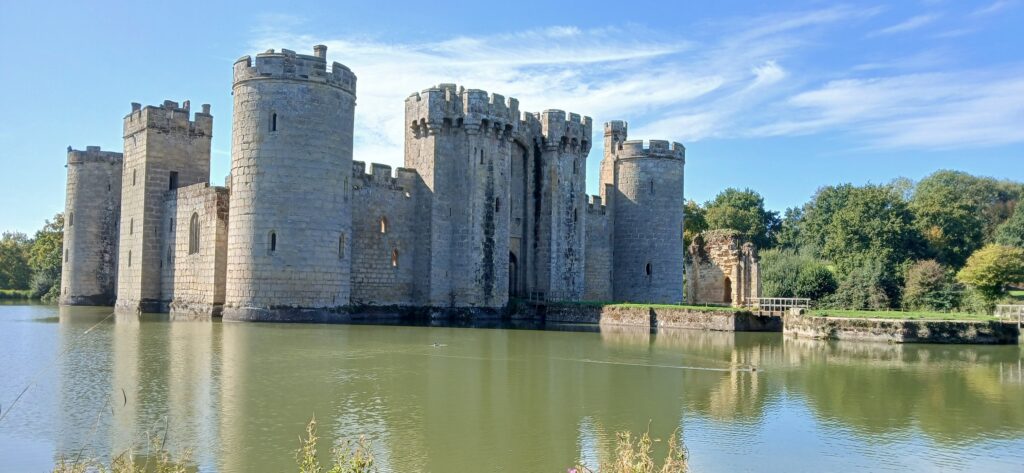
A short ride from Sompting, Bodiam Castle is more than a fort for the body. Its builders had a profound interest in mathematics, encoding a philosophical purpose into its design to guide the mind. The castle’s interest in maths was intended to create a cadre within chivalry, making soldiers share a common perspective and culture.
The true re-emergence of the Anglo-Saxon soul can be seen in places like Bodiam Castle, which in ancient days was only a short ride away.
Built centuries after the conquest. This formidable fortress seems purely Norman in its power, but a closer look reveals a different story.
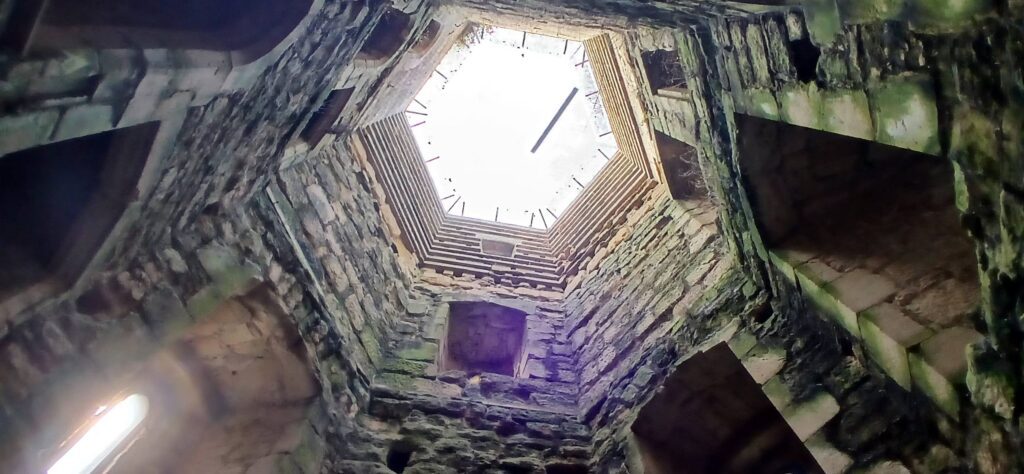
The builders’ interest in mathematics is visible here, as we look up the hexagonal shaft of a tower at Bodiam Castle.
As the Byrga Geniht video explains, its builders REALLY LIKED MATHEMATICS, and the design is rooted in a philosophical tradition of geometry and proportion. These were not new ideas, but a continuation of the same intellectual and spiritual currents that flowed through pre-conquest England.
The Saxon legacy of sophisticated craftsmanship and a deep connection to ideal forms had not vanished; it had merely been submerged. It re-emerged in the architecture of the new age, reshaping it from within.
Winchester
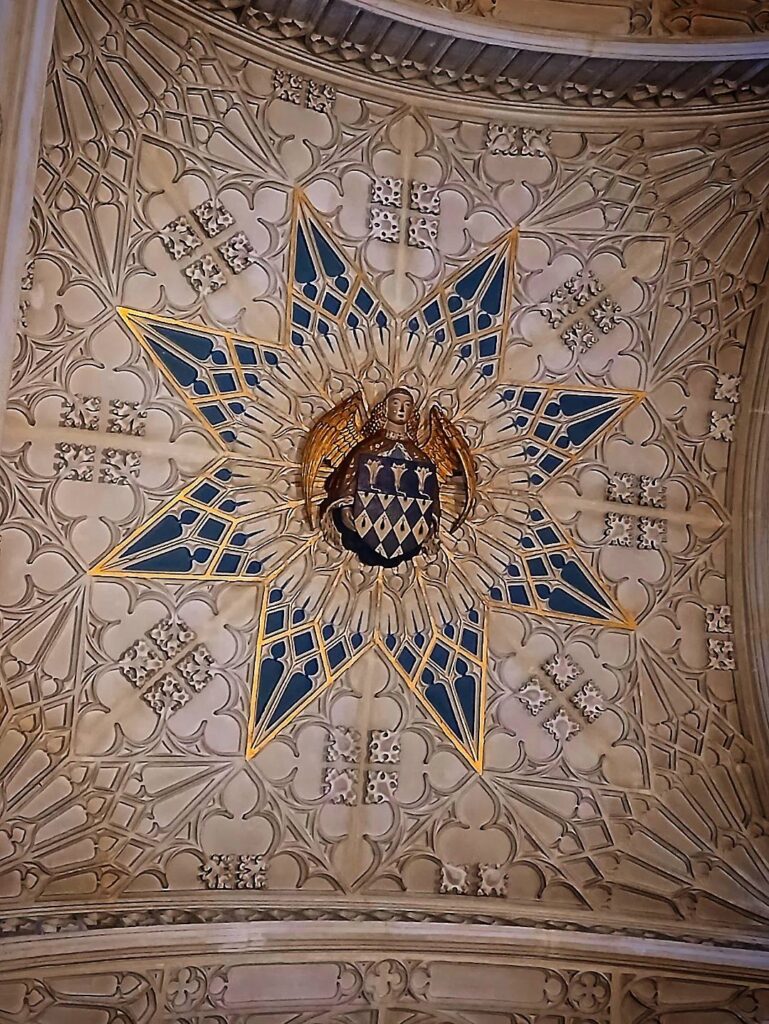
The chantry chapel and tomb of William of Waynflete, Bishop of Winchester, distinguished by its intriguing carvings.
At Winchester, the heart of the Saxon nation, the cultural light of Saxon perspectives proved hard to extinguish.
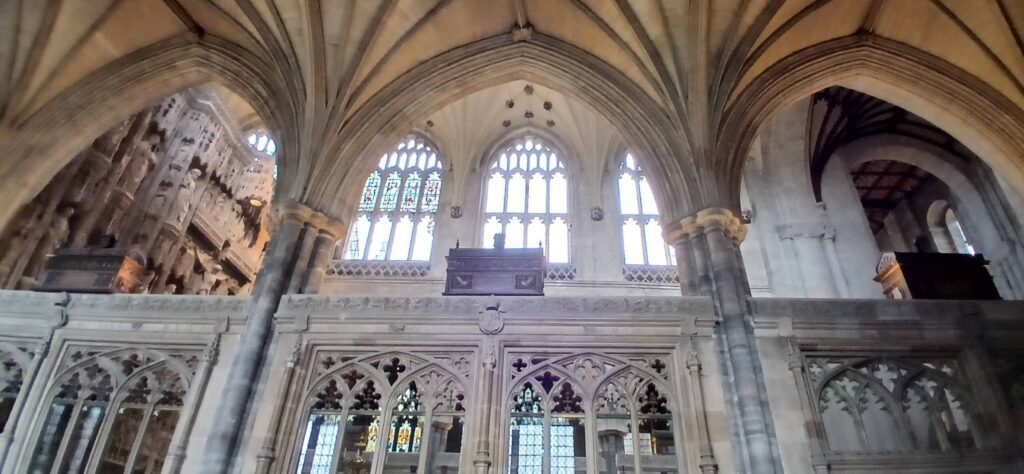
The mortuary chests at Winchester Cathedral, the final resting place of early English monarchs and religious leaders.
In the cathedral, the famous mortuary chests hold the bones of the Anglo-Saxon kings, their remains commingled and buried—a powerful symbol of a dynasty put to rest.

Bones associated with the bone chests at Wessex. These contain the remains of early Anglo-Saxon monarchs and later figures who were central to the story of England, including King Canute and Queen Emma, who ruled the political world Harold Godwinson was born into. Canute is of particular note to Soulton Hall, as he famously murdered Beothric, the Lord of Soulton, underscoring the brutal politics that shaped Harold’s world. Also present is Bishop Stigand, the controversial figure who crowned Harold king, highlighting the difficult legacy that the last Saxon king inherited.
At the cathedral, the story of the Saxon saint, St. Swithun, is of great interest, providing a compelling parallel to our earlier discussion of the relics and Duke William. His relics illustrate the evolving role of sacred objects in English history, a history our founder, Sir Rowland Hill, would have been deeply familiar with due to his interest in the Saxon period and its heritage. St. Swithun’s story is also connected to Old Sir Rowland Hill’s wider political existence: as a politician of his time, he had to approach his statecraft with huge sensitivity. Serving during the Reformation as a privy councilor and a colleague of Thomas Wriothesley, a key figure in the suppression of religious relics, Sir Rowland witnessed this history firsthand. The relics of St. Swithun were, it is said, hidden away ahead of the commissioners’ visit, of which they had a good amount of notice.
This act of preservation, if it happened which is debated, reflects a continued reverence for the past, a sentiment that Sir Rowland would have been deeply aware of.
It was a great opportunity to also visit the Great Hall in Winchester.
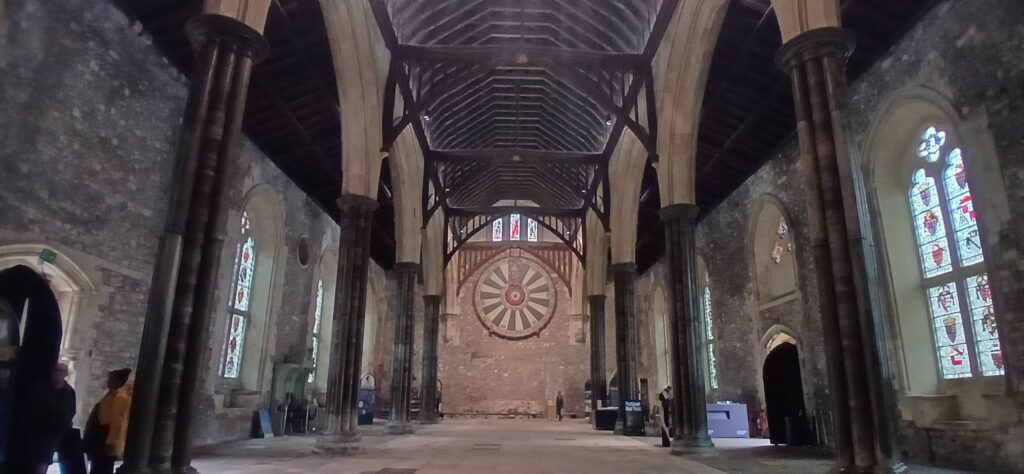
Henry III’s Great Hall at Winchester
Constructed by King Henry III, who ascended the throne as a boy in a time of great instability, his political statecraft was characterized by his invoking of the “Saxonness” of himself and of England.
His motivation for this was clear: needing to appeal to the population at large as a stakeholder to resist the powerful barons, his interest in the Saxons was a powerful act to stabilize the country. It was part of the rowing back of the 1066 driving of Saxon identity from the mind of England, a move that served as a ballast against the Norman heritage of the feudal class.
********

Scholarly reconstruction of Soulton Hall in accession created by James D. Wenn and James R. Syrett of Byrga Geniht Ltd for Soulton Hall in 2024.
The Saxon soul was not extinguished. It survived in a defiant tower, was enshrined in the bones of its kings, and eventually re-emerged, shaping a blended national identity. This is a story Sir Rowland understood well, as he too worked to embody enduring principles amidst the upheaval of his own time.

James D. Wenn, Heritage Expert and Consultant
The themes of Saxon identity and its continuity in English heritage, as explored in this blog, draw upon the extensive work of our heritage consultants, Byrga Geniht. For a deeper dive into their insights, please follow this link.
