

Shadows of the Past: Secrecy and the Construction of History
The BBC’s Miss Austen has garnered rave reviews, and we are finding it deeply enjoyable. Beyond its clever premise and engaging performances, the series offers a sophisticated exploration of how legacies are constructed and manipulated, particularly focusing on the role of Cassandra Austen in shaping her sister’s posthumous reputation.
One of the series’ most compelling aspects is its portrayal of Cassandra’s calculated efforts to protect and curate Jane’s memory. Her guardianship of Jane’s letters and papers becomes a powerful metaphor for the ways in which families often manage the legacies of their loved ones, selectively emphasizing certain aspects while downplaying others.
‘Historians, you think,’ said Miss Tilney, ‘are not happy… They display imagination without raising interest. I am fond of history – and am very well contented to take the false with the true.
– Jane Austin, Northanger Abbey (Chapter 14)
This is not presented as a simple act of deception, but rather as a complex negotiation between honouring the truth and safeguarding a carefully crafted image.

Jane AustenThe BBC’s Miss Austen resonates particularly strongly at Soulton for two key reasons.
First, Jane Austen’s lineage traces back to Sir Rowland Hill of Soulton. Hill mentored and acted as guardian to Thomas Leigh, who then married Hill’s niece, Alice Barker. This union established the Leigh family line, from which Austen descended, connecting the author to a significant Tudor figure.
Second, the series’ exploration of legacy curation finds a striking parallel in Hill’s own posthumous reputation. His story has been subject to overwriting and confusion steming from the use of aliases, resulting in a complex and even now highly charged legacy that requires careful attention and handling.
Seldom, very seldom does complete truth belong to any human disclosure; seldom can it happen that something is not a little disguised, or a little mistaken
– Jane Austin, Emma, Volume II, Chapter 16
The themes of prioritizing right over tyranny, enlightenment, education, care for the needy, internationalism, pluralism, moral agency, and even democracy with which Sir Rowland Hill was and could be associated made him a challenging figure from his death in 1561 onward. His complex legacy, subject to overwriting and the use of aliases, remains even now highly charged and requires careful attention. Various controversies, from the Chartists and Suffragettes to the proponents of the American Revolution and the Parliamentarians in the War of the Three Kingdoms/English Civil War, have all drawn inspiration from his multifaceted and often contested legacy (if it was lowed to be well known enough to be contested that is).
In a reflection of these themes, Miss Austen also sets on the board characters who are less invested in the truth and care for a person’s memory and are instead individuals who prioritize personal agendas or seek to exploit Jane’s posthumous fame.

Statue of Old Sir Rowland Hill: holding Magna Carta and looking at Soulton Hall, his house
These figures serve as a crucial reminder that history is rarely an objective and unbiased account of events; instead, it is a narrative constructed by individuals with their own perspectives, motivations, and potential biases. And sometimes, things are hidden, deliberately concealed, occasionally for extended periods. One need only consider the “thirty-year rule” on state papers and the use of D-Notices in our own time to understand how information can be withheld, shaping the historical narrative for generations.
What could I do! Facts are such horrid things!
– Jane Austin, Lady Susan XXXII (Mrs. Johnson to Lady Susan)
As the series asserts, “History is rhetoric,” a statement that resonates deeply with the central themes of the narrative. This is an idea with which Soulton, even now, is intimately familiar.
This assertion—that history is not objective record but persuasive argument—encapsulates the series’ core message. It highlights how stories are told with specific purposes, shaped by those who wield the power to narrate. Miss Austen deftly employs this concept to not only dissect the construction of Jane Austen’s legacy, but also to explore the ways in which we all curate our personal histories, consciously or unconsciously choosing which elements to highlight and which to obscure.
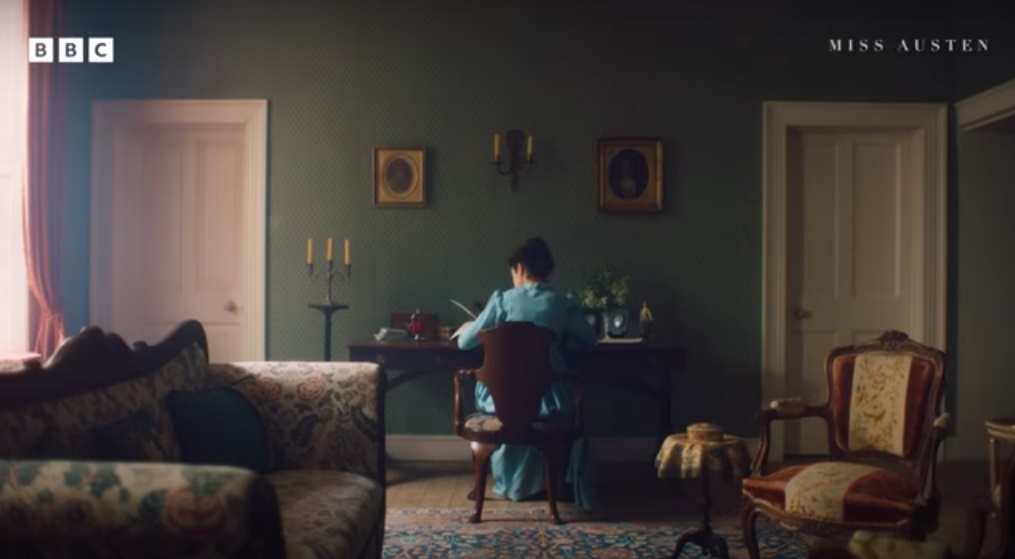
BBC’s ‘Miss Austin’
In its entirety, Miss Austen provides a nuanced and thought-provoking analysis of the processes by which history is shaped and interpreted.
ADIEU MONDE PUIS QUE TV DESCORS TOUT INFAMS…TOUT CHASTES TOUT A LA FIN ORLIVES TOUT.
– Text on an C17th portrait of Sir Rowland Hill at Altringham Park
It serves as a reminder that the stories we inherit, both about the past and about ourselves, are often carefully constructed narratives, influenced by individual desires and agendas. Even literary giants like Jane Austen are not immune to this process of historical revision.
Consequently, Miss Austen encourages us to engage with historical narratives critically, recognizing that there is often more to the story than what is readily apparent.
