

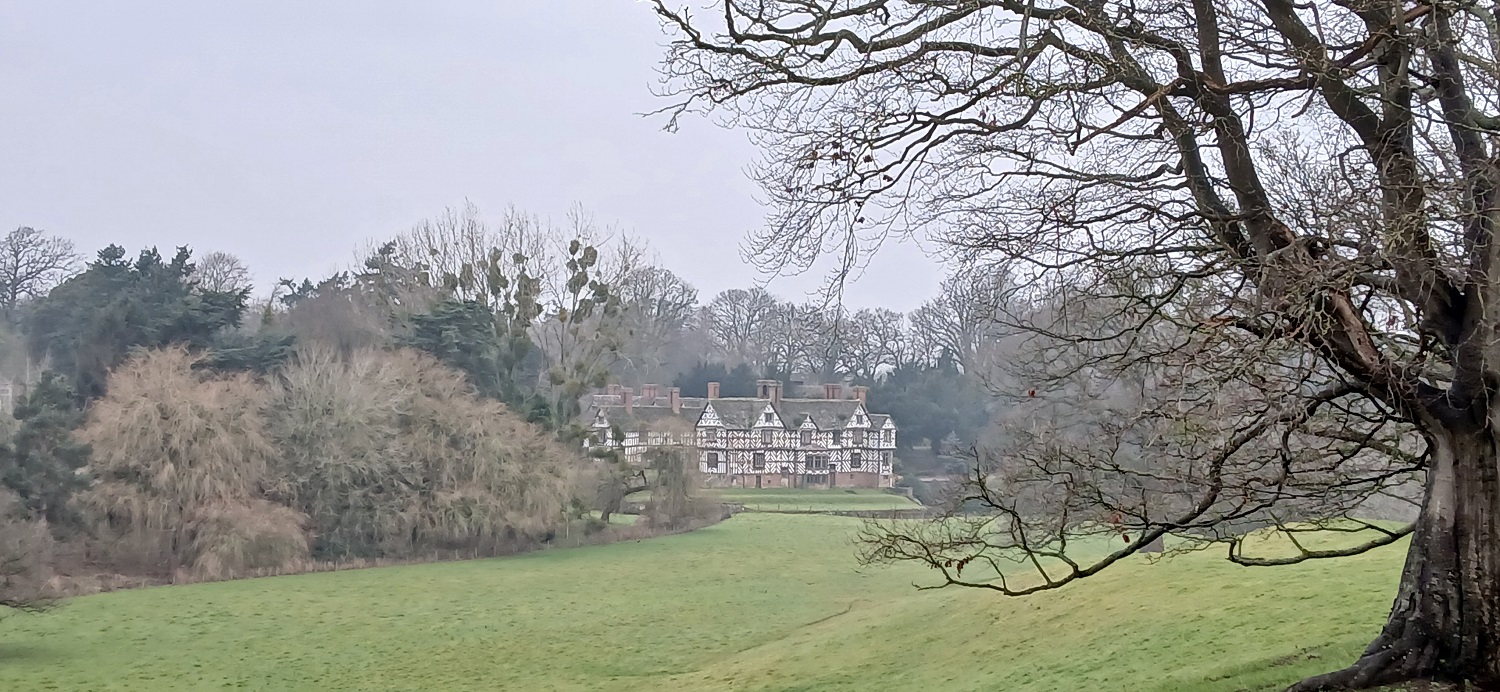
Pitchford Hall: Tudor Design Delight
For AGES we have been trying to coordinate a meet-up with our fellow Historic Houses House Member Pitchford Hall, a recent trip took us past, offering only a fleeting glimpse was enough to justify a blog post.
Pitchford is truly amazing, steeped in history and radiating an undeniable charm.
This outstanding Tudor country house nestled in the Shropshire village of Pitchford, is a treasure which is of roughly the same age as Soulton Hall.
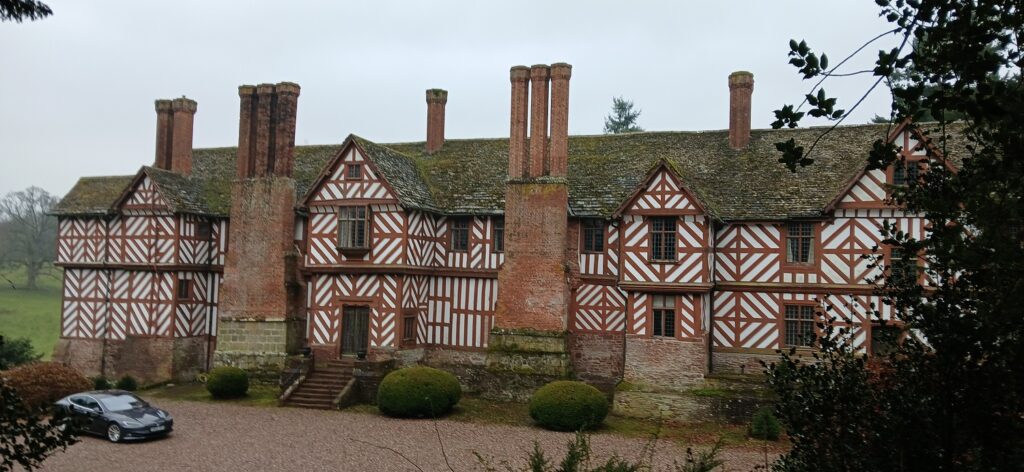
Geometric Façade of Pitchford Hall
Just six miles southeast of Shrewsbury, this remarkable building whispers tales of centuries past. Built around 1560 on the foundations of a medieval predecessor, the hall has seen its share of renovations and expansions, most notably in the 1870s and 80s. The striking timber-framed structure, with its rendered red sandstone panels, stone roof, and imposing brick chimneys, presents a captivating facade. The E-shaped floor plan, centered around a southern courtyard, hints at the home’s rich history, while the Victorian service wing adds another layer to its story.
And that’s just the beginning! The grounds boast an orangery (recently restored), a walled garden, and the remnants of a deer park established in 1638.
One of the most fascinating aspects of Pitchford Hall is its connection to the natural world. A bitumen well, from which the village derives its name, provided pitch for waterproofing the house’s timbers.
A 17th-century tree house, one of the oldest in the world, stands proudly in a large lime tree, a testament to the longevity and grandeur of the estate. Like herre a stretch Roman Road cuthes though the landscape (in this case Watling Street, not Via Devana though) cuts through the property, linking the hall to two millennia of history.
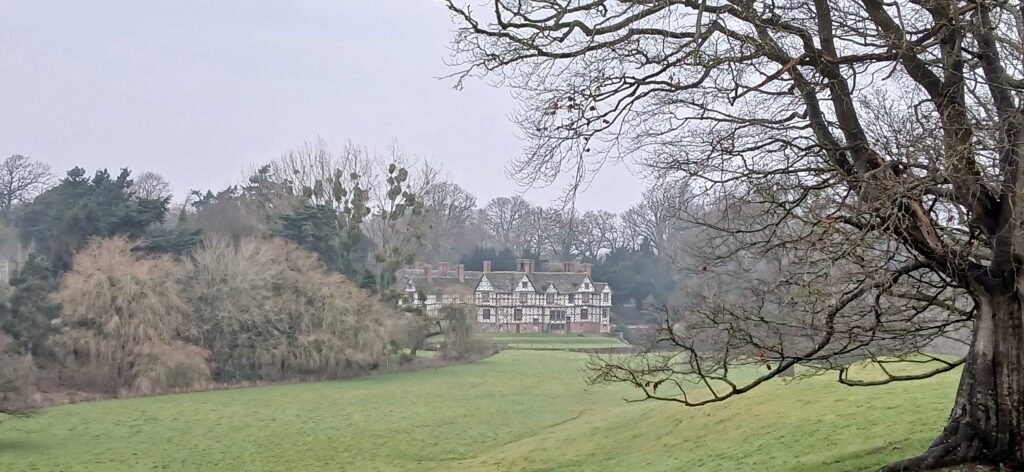
Pitchford Hall
The hall’s story is as captivating as its architecture.
From its origins as a manor house in the 13th century, through the ownership of the de Pykeford family and later the Ottleys, the hall has witnessed generations come and go.
It even played a role in the Civil War, offering refuge to Prince Rupert (who seems to have visited Soulton).
Princess Victoria was charmed by the “curious looking but very comfortable house,” and her visit in 1832 left behind a sketch and a memorable diary entry.
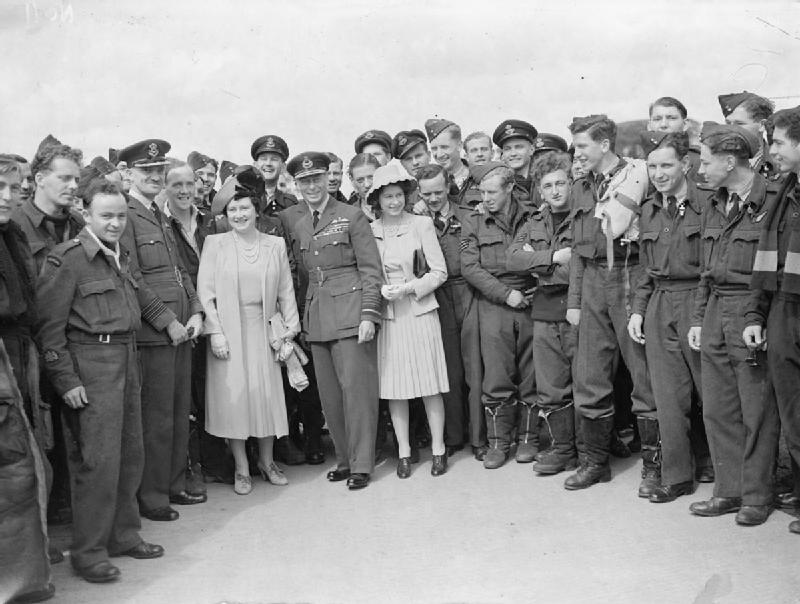
King George VI, Queen Elizabeth, and Princess Elizabeth during World War II
The hall also served as a potential retreat for the royal family during World War II, a testament to its enduring significance and the wider importance of this area strategically . During World War II, top-secret plans were in place to evacuate the Royal Family to the Midlands in the event of a Nazi invasion. King George VI, Queen Elizabeth, and the young princesses would have been moved to Madresfield Court in Malvern, Worcestershire, with other members of the Royal Family potentially going to Pitchford Hall in Shropshire. A clandestine resistance force, was trained to protect the royals and sabotage German efforts. These individuals were prepared to operate from hidden underground bunkers, carrying out assassinations and disrupting enemy movements. The government, including Prime Minister Winston Churchill, would have also relocated to the Midlands, establishing offices in various towns throughout the area. To maintain public morale and ensure continued communication, the BBC would have moved its operations to the region as well. Should the situation have deteriorated further, the Royal Family would have been evacuated northwest to Liverpool, where they would have boarded a ship bound for Canada.
Fortunately, these plans were never put into action, as Hitler’s attention turned eastward after the Battle of Britain. The existence of these contingency plans, and the secret army trained to enact them, remained shrouded in secrecy for decades.
Today, a painstaking process of restoration is underway, breathing new life into this remarkable piece of our heritage. Here is a lovely video from the American Viscontess about this house and the adventure of renewing it in this generation.
It’s a place that deserves to be celebrated. And we will update this blog when we have fixed our diaries!
********
The complementary relationship between Pitchford Hall and the adjacent St. Michael’s Church underscores the intertwined history of the manor and its community.
These two structures, exist in a harmonious dialogue, each enhancing our understanding of the other.
The grandeur of the Tudor Hall, is balanced by the spiritual presence of the church, its ancient stones echoing with centuries of communal worship and civic life.
Their shared history is palpable; the families who resided in the Hall or on its site played a significant role in the patronage and development of the church, while the church, in turn, provided a spiritual focal point for the village and those connected to the estate. St. Michael’s Church several hatchments, some of which are very modern as examples of the continuation of this tradition – which is delightful.
he 13th-century Tomb of John De Pitchford, housed within St. Michael and All Angels’ Church, Pitchford, holds significant importance as a remarkable work of art. This oak effigy, one of only three surviving 13th-century wooden tombs in England, is in an exceptional state of preservation. The intricate details of the carving, from the knight’s attire to the heraldic shields adorning the tomb chest, offer valuable insights into the craftsmanship and funerary practices of the period. Its remarkable condition further elevates its significance, allowing us to appreciate the artistry and skill of the medieval artisans who created this enduring monument.
