

We are often askedwho the architect of Soulton Hall was. And it is a question that has been asked in recent scholarship:
There must have been an important master mason behind the house’s design; if only we knew more about the original build.
– Williams, Gareth (1 June 2021). The Country Houses of Shropshire (1 ed.). Boydell and Brewer Limited.
While definitive proof remains elusive, local tradition suggests that Sir Rowland Hill and Matthew Parker were personally involved in the project, perhaps as part of a wider circle of intellectuals dedicated to preserving knowledge through building.
Some sources have proposed Henryk van Passe’s involvement at Bach y Graig (though this suggestion is debated and not one we have found reason to accept), and his acknowledged involvement in the Royal Exchange certainly placed him within influential circles. It is, though, worth briefly pausing to consider developments on the continent of Europe, such as at Tycho Brahe’s Uraniborg. This sandstone and limestone-framed brick building, constructed between 1576 and 1580 in the Flemish Renaissance style, was overseen by Danish architect Hans van Emden.
The reason for bringing Uraniborg to the reader’s attention is to illustrate the level of connectedness among intellectual and, particularly, merchant classes, and the elite in general, during this period, and how they were clearly inspiring each other. For example, on March 20, 1590, James I and VI visited Uraniborg, where the second floor contained a room specifically reserved for visiting royalty. And there can be no doubt that Richard Clough was aware of Tycho Brahe and his work.
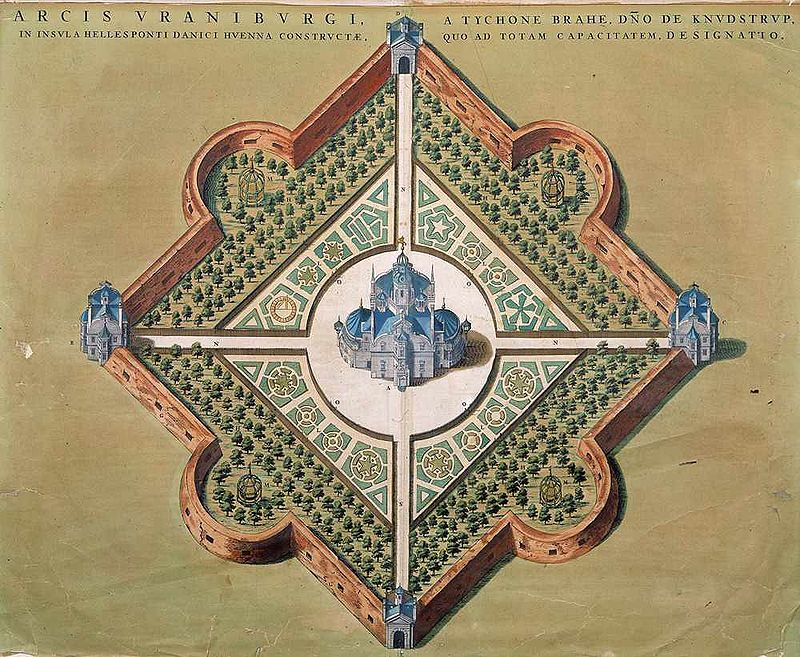
Tycho Brahe’s Uraniborg from Blaeu’s Atlas Maior (1663)
However, it’s crucial to understand that imposing the modern concept of “architect” onto the 1550s, when Soulton Hall was built, is potentially anachronistic. While master masons had existed for centuries, and the influence of commissioners and clients on their craft is clear, the idea of a distinct architectural profession was only just beginning to emerge.
The title of “first architect” is quite an accolade, and in the UK, Robert Smythson is widely viewed as holding this distinction.
Smythson, known for designing notable Elizabethan houses like Wollaton Hall, Hardwick Hall, Bolsover Castle, and Burton Agnes Hall, is first mentioned in historical records in 1556 as a stonemason at Longleat. However, while Smythson’s later work demonstrates a move towards a more recognizably “architectural” approach, it’s important to remember that Soulton Hall predates his rise to prominence.
Indeed, buildings like Hardwick Hall and Bolsover Castle, also attributed to Smythson, while undeniably impressive, seem to prioritize a less intellectually “taught” approach, opting for a more showy and perhaps even idiosyncratic expression of architectural ambition.
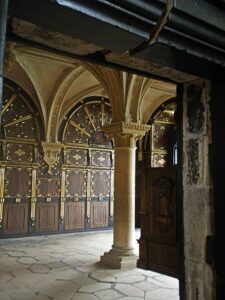
Bolsover’s pillar parlour
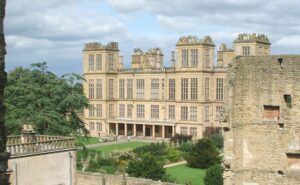
Hardwick Hall, the commission of Bess of Hardwick, which Robert Smythson had to work on as she commanded
Wollaton Hall, has a much more matter of fact articulation of Renaissance ideals, engages in a clear intellectual dialogue with the earlier Soulton Hall, suggesting a shared understanding of contemporary design principles.
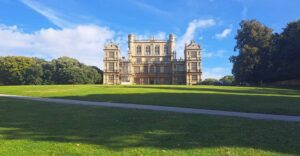
Wollaton Hall: an architectural cousin of Soulton Hall
Furthermore, it’s clear that the clients in both cases possessed a strong vision, with distinct ideas they wished to communicate through the fabric of their respective buildings.
This difference underscores the significant impact of client preferences and desires on the final form of the building that emerges from their collaboration with the master masons and builders. It reinforces the importance of considering the client’s influence alongside the skills of the craftsmen involved, particularly when trying to understand the design process in this era, and how that collaboration could lead to such varied architectural outcomes.
Therefore, while we search for a named individual behind Soulton Hall’s design, it’s more accurate to consider the possibility of a master mason, or a collaborative effort influenced by patrons and intellectuals like Sir Rowland Hill and Matthew Parker, rather than a single “architect” in the modern sense. The craftsmanship and design of Soulton Hall likely reflect the combined skills and vision of various individuals working within the building traditions of the time and
