

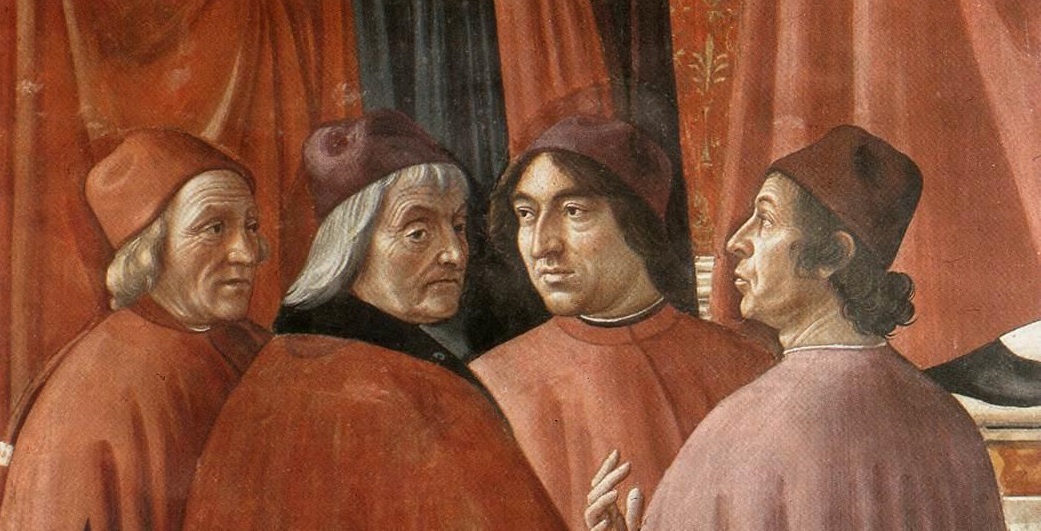
Ficino: A Renaissance Visionary
Marsilio Ficino, a towering figure of the Italian Renaissance, ignited a philosophical and spiritual revival. Born in 1433, he dedicated his life to understanding and interpreting Plato’s profound works. Under the patronage of the Medici family, Ficino established the Platonic Academy of Florence, a vibrant intellectual hub that rekindled interest in classical philosophy.

Domenico Ghirlandaio: Zachariah in the Temple (detail): Marsilio Ficino. Fresco. Santa Maria Novella, Cappella Tornabuoni, Florence, Italy. 1486-1490.
Ficino’s most significant contribution lies in his attempt to reconcile Platonic philosophy with Christian theology. He believed that both traditions shared a common core of spiritual truth, emphasizing the divine nature of the human soul and its ultimate destiny. His ideas profoundly influenced the Renaissance and beyond, inspiring countless thinkers and artists.
Ficino’s translations of Plato’s dialogues became foundational texts for Western philosophy. His writings on astrology, medicine, and natural philosophy further enriched the intellectual life of his time. His exploration of the human soul, the nature of reality, and the pursuit of wisdom remains relevant today. By studying his work, we can gain a deeper understanding of the Renaissance and the enduring power of philosophical inquiry.
While Marsilio Ficino and Sir Rowland Hill are separated by nearly a century, their shared interest in Neoplatonism provides an intriguing connection. Neoplatonism, a philosophical and religious movement, emphasized the transcendent nature of reality and the soul’s ascent to the divine.
Old Sir Rowland Hill, was a patron of the arts and a polymath with a wide range of interests. His association with Soulton Hall, his family estate in Shropshire, further highlights this connection. The architecture and design of Soulton Hall incorporate elements that reflect Neoplatonic ideas, such as references to Eleusis and Solomon’s Temple, both significant sites of ancient mystery and symbolism.
These references suggest that Hill, like many other Renaissance thinkers, was drawn to Neoplatonism. He was influenced by Ficino’s work around public health and medicine as well as how he popularized Platonic philosophy during the Renaissance.
By incorporating Neoplatonic symbolism into his home, Hill sought to create a space that reflected his own spiritual aspirations and intellectual pursuits.
In conclusion, their shared interest in Neoplatonism provides a fascinating link between two significant figures of the Renaissance and the Tudor era. It highlights the enduring appeal of Neoplatonic thought and its influence on art, architecture, and spirituality throughout the centuries.
