

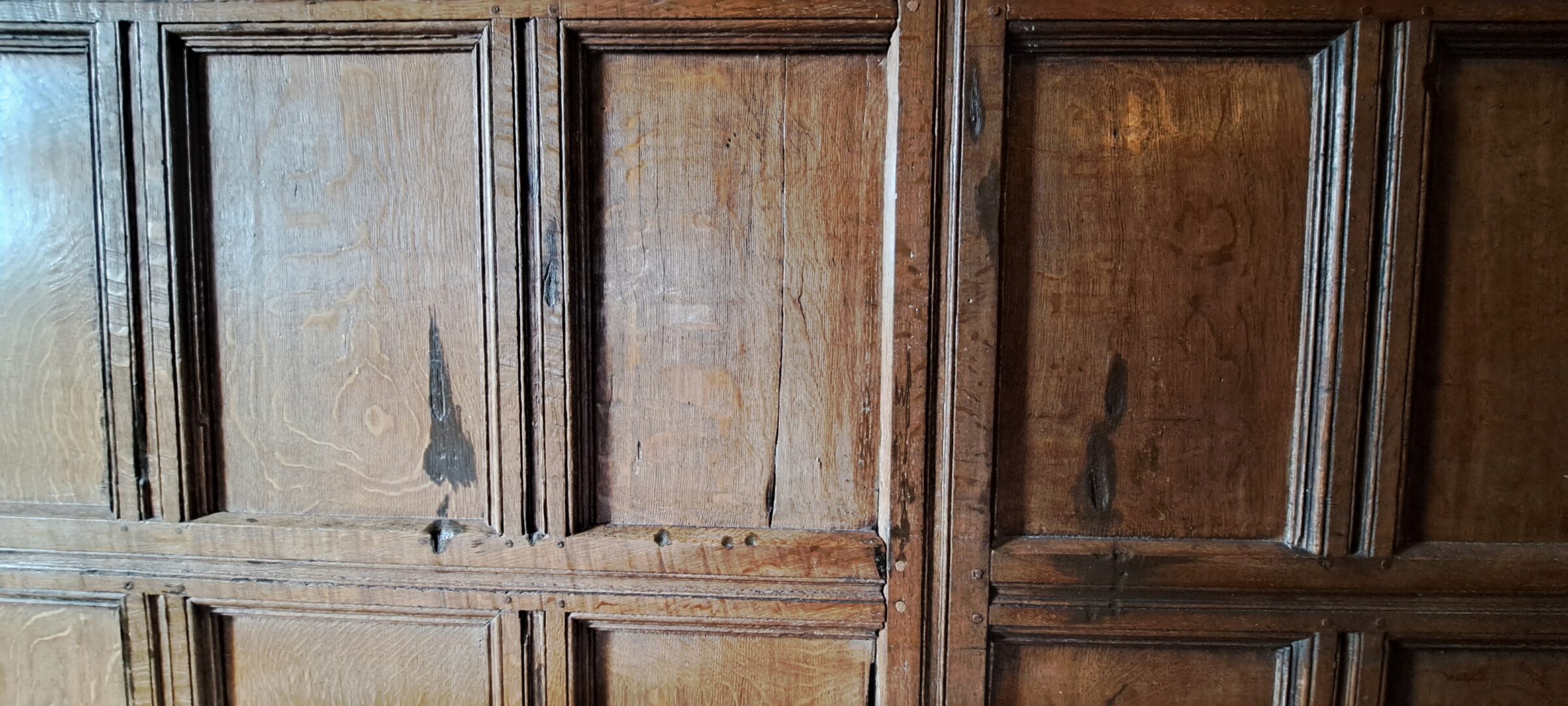
This room boasts original wood panelling dating back to the 16th and 17th centuries. While much of it appears uniform, closer inspection reveals subtle differences. The section near the fireplace, dating to Old Sir Rowland Hill’s time, features eight-pointed stars carved into the frieze, a detail absent from later, likely restoration-period panels.
Sir Rowland Hill’s fascination with the number eight is well-known, connecting to ancient Greek dance traditions. This room offers a prime view of Soulton Wood, the inspiration for Thomas Lodge Jr.’s Rosalynde (1590), which in turn inspired Shakespeare’s As You Like It. The play’s romantic lead, Orlando, is the son of Old Sir Rowland’s, and the woodland setting mirrors Soulton Wood.
Closer to the house, a large mosaic depicts a dance for eight, its octagonal pattern symbolizing a box step and dosey-doe. This echoes the play’s conclusion, where the characters who have found harmony in marriage are divinely instructed to form a dance of eight couples by Hymen:
Peace, ho! I bar confusion:
‘Tis I must make conclusion
Of these most strange events:
Here’s eight that must take hands
To join in Hymen’s bands,
If truth holds true contents.
That dance has survived in the culture of this house, the home of a cousin of William Shakespeare’s mother.
You may notice a significant slope to the floor of this room. This is associated with the insertion of the Ædicule (termed a chapel to those less familiar with this house, though it was likely not used in quite that way in Old Sir Rowland’s time and was more of a work of conceptual art). That room was so important that it interfered with the structural configuration of the house, and later work was done to address this, only after the floor began to show the strain of this choice a century after the house was built.
That room also has the only central window on the cube of Soulton Hall and appears on the only truly symmetrical face of the building. The entire house is aligned from the room’s axis to the rising sun on Easter morning.
This room has the most intact interior from Old Sir Rowland’s time, reflecting the way the house suffered from ransacking during the Civil War. The library of the publisher of the Geneva Bible, a work of huge epistemological and constitutional force in that period of conflict and dispute, was located here. This hugely impactful valley of Old Sir Rowland Hill’s life contributed to the setting aside of his legacy in the context of the American Declaration of Independence and the Troubles in Northern Ireland. In Shropshire, however, he was never forgotten, as the massive statue to him visible from the smaller window attests.
