


Alcuin of York: A Scholar and Statesman of the Carolingian Renaissance on In Our Time
In a recent BBC Radio 4 In Our Time program, Melvyn Bragg and his guests delved into the life and legacy of Alcuin of York, a pivotal figure in the Carolingian Renaissance. You can find it here.
Alcuin, who lived from around 735 to 804 AD, played a fundamental role in promoting education as a valuable goal in itself.
Born near York, Alcuin spent much of his life in Northumbria, where he honed his intellectual skills. His proficiency in various subjects led him to be invited to Charlemagne‘s court in Aachen. There, he introduced Anglo-Saxon humanism, emphasizing the importance of a broad liberal education for both personal growth and a deeper understanding of Christian doctrine.
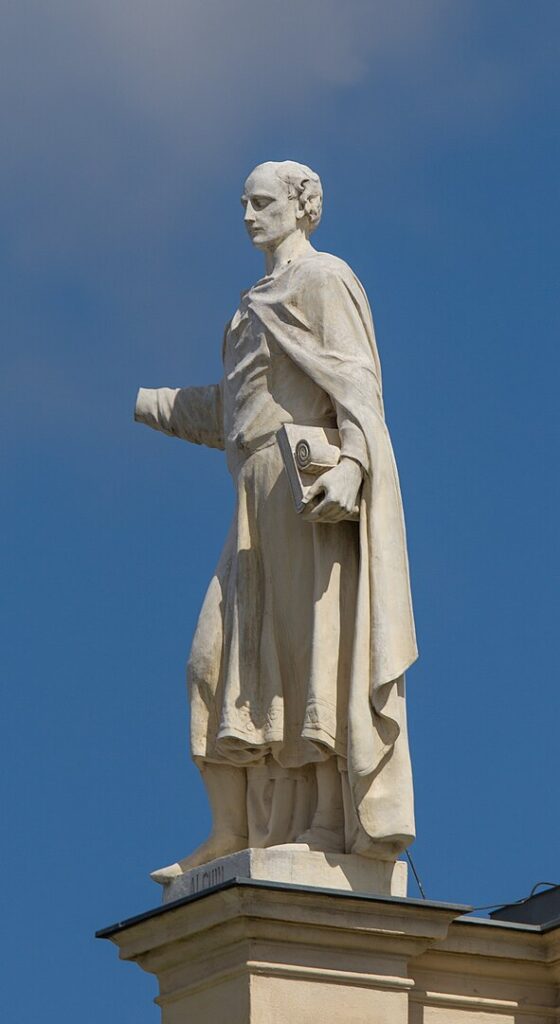
Alcuin, roof figure, Museum of History of Arts, Vienna
Alcuin’s contributions to the Carolingian Renaissance were significant. He wrote extensively, leaving behind letters that offer invaluable insights into his life and times. His work also included poetry and scholarly treatises that helped shape the intellectual landscape of the era.
One of Alcuin’s notable achievements was his role in developing the Carolingian script, which influenced the Roman typeface we use today. He served as abbot at Marmoutier, Tours, where the monks were actively engaged in refining this new script.
The question of whether Alcuin of York was gay is a complex and debated topic among historians. While there is no definitive evidence to prove or disprove this claim, some scholars have pointed to certain aspects of his life and writings as potential indicators. These include homoerotic language in his letters, close relationships with male students and colleagues, and the cultural and social norms of the 8th century. It is important to note that there are also alternative explanations for these factors, and the question ultimately remains a matter of scholarly debate.
Alcuin of York was a true Renaissance man of the 8th century. His dedication to education, his intellectual pursuits, and his contributions to the Carolingian Renaissance left a lasting legacy. By highlighting the importance of a broad liberal education and fostering intellectual growth, Alcuin helped to shape the course of Western civilization.
