


Lichfield, a charming city nested in the heart of Staffordshire, England, is renowned for its stunning cathedral.
The cathedral, a saxon foundation, is now a masterpiece of Gothic architecture, with its soaring spires and intricate carvings.
It is dedicated to the Virgin Mary and Chad of Mercia, Bishop of the Northumbrians, later Bishop of the Mercians and Lindsey People, and Saint (c. 634–672), and Chad was originally buried in the Church of Saint Mary which became part of the cathedral.
Bede records that, St. Chad, a contempory of St Erkenwald, established his See at Lichfield in 669, and the first cathedral was built on the this site.
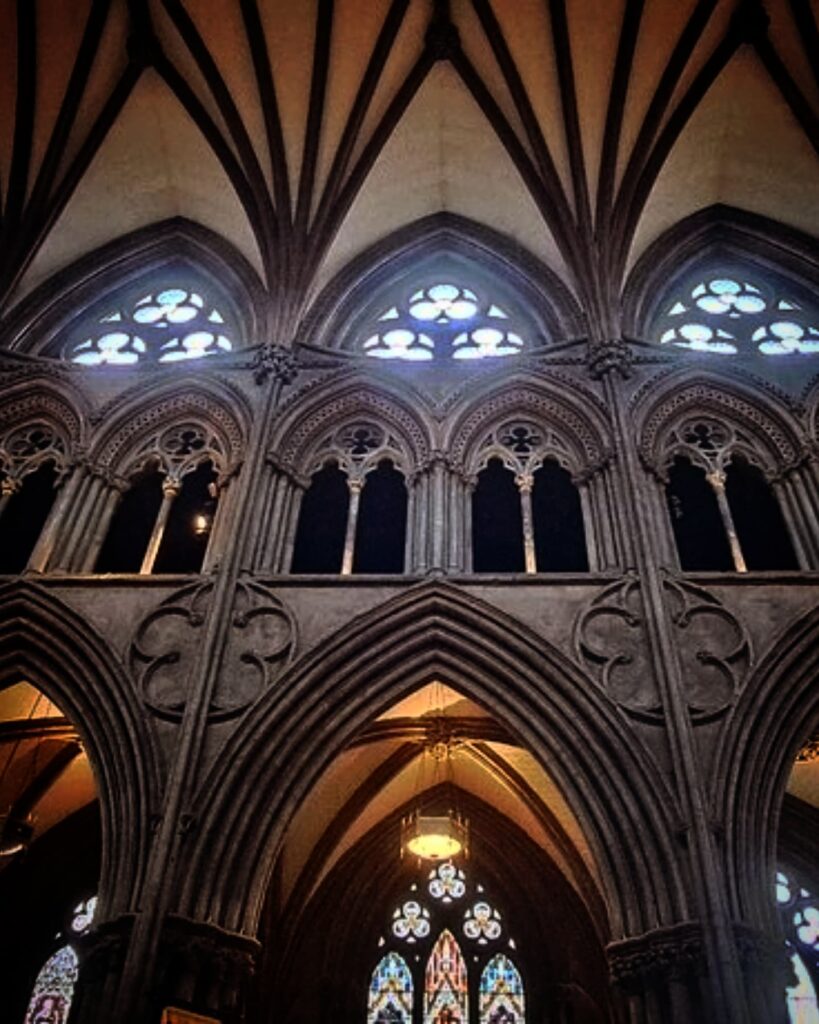
Lichfield Cathedral, the Clerestory Windows.
When Chad died in 672, his grave became a shrine for pilgrims. In 2003, excavations revealed a grave cut into the sandstone bedrock, believed to be Chad’s.
In 787, King Offa of Mercia elevated Lichfield to an archbishopric, overseeing all bishops from the Humber to the Thames. This status lasted for 14 years.
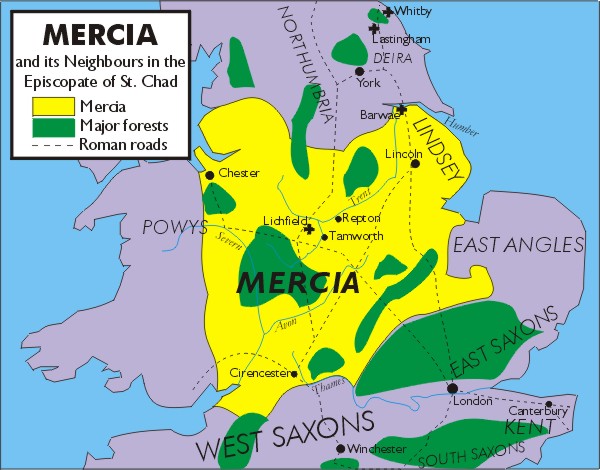
Mercia in the time of Chad: note the Forest of Arden reaching beyond Watling Street
In 1854, a foundation was discovered beneath the choir and presbytery. This basilica-shaped structure is believed to be the second cathedral. While previously attributed to the Normans, its characteristics suggest a construction date during Offa’s archbishopric.
The construction of the present Gothic cathedral began in the early 13th century. Its fabric accounts were unfortunately destroyed during the Civil War, making it difficult to pinpoint the exact date.
One of the most significant recent events at the cathedral was the return of a relic of St. Chad in November 2022. This historic event marked a moment of reconciliation and unity between the Anglican and Roman Catholic churches. The relic now resides in a monument within the cathedral, inviting visitors to reflect.

A place of pilgrimage and prayer, the Shrine of St. Chad offers a connection to the past and a source of inspiration for the future.
The journey of St. Chad’s relics after the Reformation is a fascinating tale of survival, perseverance, and faith. Despite the turbulent times and the distruction of the shrine, the relics managed to evade being lost and were preserved.
The story begins with Prebendary Arthur Dudley, who discreetly removed the relics from Lichfield Cathedral during the Reformation. They were then passed to his nieces, Bridget and Katherine Dudley, who kept them safe at Russells Hall.
Decades later, the relics resurfaced in a surprising manner. A dying farmer named Henry Hodgetts revealed the location of the relics to a priest, Fr Peter Turner SJ. The relics were subsequently transferred to the Seminary at St Omer, France.
In the 19th century, the relics were acquired by Sir Thomas Fitzherbert-Brockholes, who put them in his private chapel. After his death, the relics were discovered by his chaplain, Fr Benjamin Hulme, who presented them to Bishop Thomas Walsh.
The relics were then brought to the newly opened St. Chad’s Cathedral in Birmingham, where they remain to this day alongside the new Lichfield arrangements.
********
Lichfield is a picturesque town in Staffordshire, England, offers a delightful blend of history, culture, and natural beauty. With its well-preserved medieval center, charming streets, and stunning architecture, Lichfield is a captivating destination for visitors.
One of the town’s most notable attractions is the birthplace of Samuel Johnson, a renowned English writer and lexicographer. The house where Johnson was born in 1709 has been carefully preserved and now serves as a museum, offering visitors a glimpse into the life and times of this literary giant. In addition you can explore the Erasmus Darwin Museum. Located in the former home of the renowned scientist and poet Erasmus Darwin, the museum shows fascinating exhibits related to his life, work, and the history of Lichfield.
