

A Middle English Masterpiece: The Poetic Vision of St. Erkenwald
St. Erkenwald (also St Earconwald) is a Middle English alliterative poem that revolves around a miraculous event involving the Saxon Bishop of London, St. Erkenwald, who is credited with establishing St Paul’s Cathedral.
The poem narrates the discovery of an undecayed, speaking corpse beneath St. Paul’s Cathedral. This corpse, identified as a pagan judge, raises questions about salvation and the power of intercession.

Wells Cathedral, window including Erkenwald
The poem survives in a single manuscript, British Library MS Harley 2250. Discovered in 1757 by Thomas Percy, the manuscript had been in the possession of Sir Humphrey Pitt of Balcony House, Shifnal, and Priorslee Hall, Shropshire. It had to be rescused, appraently in alarming circumstances:
An acquaintance of Dr. Percy’s has been heard to say that he rescued it from a maid servant at a country inn, who made use of it in lighting the fire. And it is remarkable, that scarcely any thing is published from it, not being to be found elsewhere
– Hales, J. W., & Furnivall, F. J. (Eds.). (1867). Percy’s Folio Manuscript: Ballads and Romances. Vol. 1. London: N. Trübner & Co.
This composite manuscript, created by binding together two unrelated texts, contains St. Erkenwald and other works. A scribal colophon in the manuscript dates it to around 1477, roughly a century after the poem’s likely composition.

A Shropshire estate where Sir Humphrey Pitt resided and from which the sole surviving manuscript of the poem St. Erkenwald was recovered.
The manuscript title of the poem is De Erkenwaldo (“About Erkenwald”), a Latin phrase. The modern title, St. Erkenwald, is a later addition.
********
The recent Remembering Erkenwald Conference featured a remarkable video created by our consultants, Byrgah Geniht Ltd. This exceptional resource offers a unique opportunity to access the poem in its original Middle English form, providing a rich and authentic experience for scholars and enthusiasts alike.
The poem begins with the construction of St. Paul’s Cathedral, when workmen unearth a magnificent tomb. Inside, they find a perfectly preserved corpse, which, to their astonishment, begins to speak. He explains he comes from a time of deep antiquity, which is possibly pre-Roman,
The corpse, revealing itself to be a pagan judge, recounts its sinful life and expresses a desire for salvation.
St. Erkenwald, hearing of the miraculous discovery, visits the cathedral and confronts the corpse. The judge implores the saint to intercede for his soul, confessing his sins and expressing a belief in the power of God’s mercy. St. Erkenwald, moved by the judge’s plea, offers prayers and blessings, and the corpse is finally granted peace.
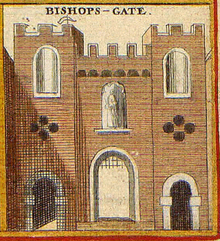
now-lost Roman gate in the walls of Roman London, repaired by St. Erkenwald and subsequently named after him.
The concept of intercession, or the act of praying on behalf of others, is a central theme in the poem. The pagan judge’s plea for salvation highlights the belief that even those who have lived sinful lives can find redemption through divine intervention. St. Erkenwald’s role as a mediator between the judge and God underscores the power of prayer and the importance of spiritual guidance.

A banner showing St Erkenwald
The poem raises theological questions about the nature of salvation, the fate of theose outside of the ‘correct’ Church, and the possibility of redemption for those who have not embraced Christianity. The judge’s story suggests that even those who have lived outside the Christian faith may find salvation through divine mercy and the intercession of saints.
St. Erkenwald is a fascinating exploration of medieval beliefs about salvation, sin, and the power of intercession.
The poem offers a glimpse into the spiritual world of the Middle Ages and the enduring hope of grace.

Saint Erkenwald St Albans Cathedral
In 1997, the Royal Shakespeare Company staged Mike Poulton’s play, “St. Erkenwald,” at the Other Place theater. This production was directed by David Hunt and offered audiences a unique exploration of the life and times of St. Erkenwald, a 7th-century Anglo-Saxon bishop.
You can also hear this poem discussed in a podcast episode of “Pop Medieval.” In “Episode 37: The Tears of St. Erkenwald,” hosts explore the tale of the 7th-century bishop.
