


Today it is 400 years since the birth of Prince Rupert.
He sent periods of the Englsih Civil War near Soulton.
Prince Rupert arrived in the district on February 18th, 1644. Welcomed by the town aldermen, he chose Shrewsbury as his headquarters. He was put to stay in what is now part of the Prince Rupert Hotel.
Shortly after establishing his base, Rupert passed by the nearby town of Wem to the west. The town apparently made a poor impression, prompting him to remark that it was a “crow’s nest” incapable of providing even a single piece of bread for his men.
He also mustered troops a short distance to the east at nearby Prees Heath.
It feels possible, even likely he visited Soulton during these days, not least becuse the Civil War was concerned with constitutional epistimology and Soulton was clearly engaged with that.
*********
Though his passion ignited later in life, Prince Rupert became a dedicated scientist during a period of scientific advancement. The founding of the Royal Society in 1660, to which he was elected just four years later, provided a platform for his curiosity and experimentation.
Rupert possessed a brilliant mathematical mind and a lifelong fascination with mechanical objects. Witnessing the evolution of warfare firsthand, he yearned for improvements in weaponry and tactics. The constant technical challenges presented by the English Civil War fueled his problem-solving drive and risk-taking spirit.
While some credit him with introducing existing European inventions to England, Rupert received recognition for several innovative ideas, including:
- Super-Powered Gunpowder: A formula for gunpowder supposedly eleven times stronger than standard.
- Early Machine Gun: A multi-shot firearm capable of rapid fire.
- Revolver Prototype: A handgun featuring a rotating barrel system.
- Improved Grapeshot: A devastating artillery weapon for anti-personnel use.
- Diving Bell: A device designed to retrieve objects from shipwrecks.
Rupert’s concern for the war-wounded led him to share his knowledge on healing processes, including burn treatment, with the Royal Society, the foundation of which involved the Hill family.
As Governor of Windsor Castle (1668-1682), Rupert transformed some apartments into a well-equipped laboratory to pursue his scientific endeavors. He also established a glass-making operation fueled by furnaces in Chelsea, much to the chagrin of nearby residents who endured the resulting air pollution.
A lover of gunnery, Rupert dedicated significant resources to perfecting iron cannons.
Rupert’s scientific pursuits embodied the burgeoning spirit of inquiry and invention that would later ignite the Industrial Revolution. Following a state funeral, he was laid to rest in Westminster Abbey, a testament to his remarkable life as a soldier and scientist.
********
Within the Rithmomachia Room in Soulton Hall there is a very old laboratory fume cupboard which is not from the 1550s Rowland Hill phase, and liekly dates from a period which this blog is conceredn with.
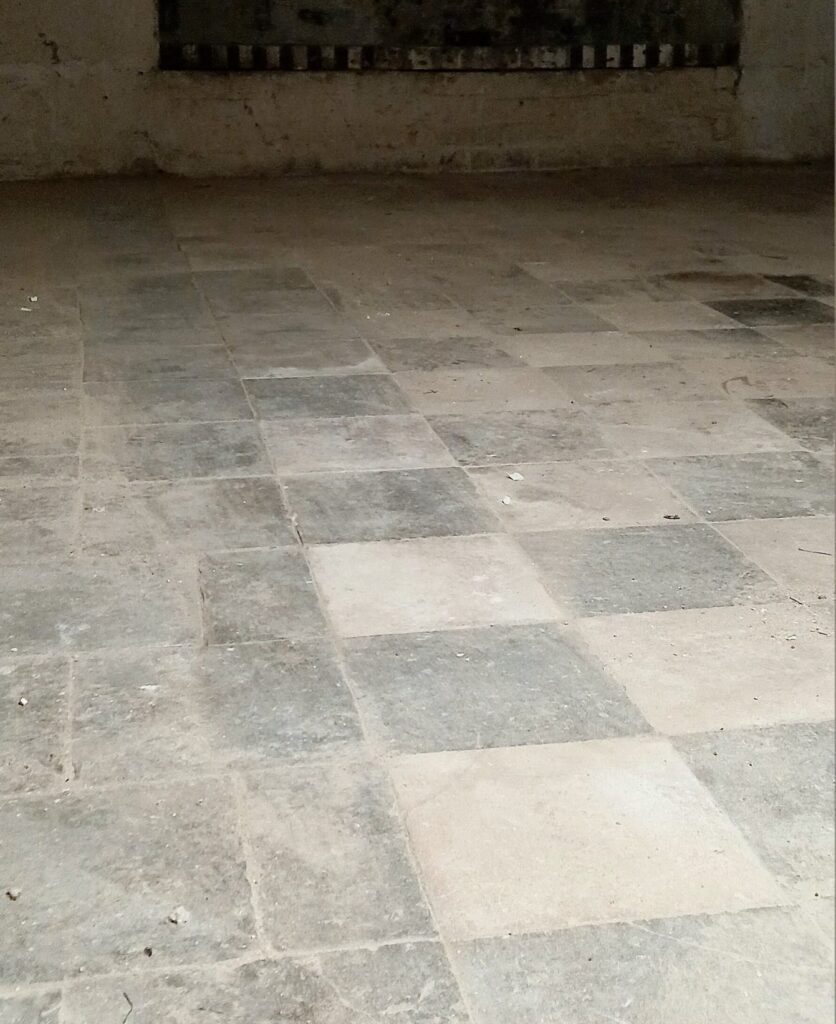
The Rithmomachia Pavement in the Prayer Room of Soulton Hall – 2022, awaiting conservation.
********
This blog was updated in 2024. It includes matters on which Byrgah Geniht is advising the Ashton family of Soulton Hall.
Further reading:
