


Soulton Hall was built as a deliberate setting for reflection, where sixteenth-century solar geometry and structural optics map a specific narrative cycle.
The house carries its history through a “self-admitting code” built into the stone. While these observations are a long-standing part of the culture of the house, this archive marks the first formal effort to record them as a cohesive, day-to-day reference in public.
The design reflects the intellectual humility and scholarship of figures such as Sir Rowland Hill and Matthew Parker. Their influence suggests a Neoplatonic approach, where the physical world is arranged to reveal deeper truths through the precise movement of light and shadow. We are updating this record during Holy Week 2026 to document each occurrence on its corresponding day.
We are photpgraphing these phenomena as they occur in real time, creating a digital archive of how the house carries itself through this sequence. Each entry below will be updated to reflect the observations of the corresponding day.
The Prayer Room and the Sequence of Maundy Thursday
The architectural narrative begins in the basement of the hall, within a prayer room defined by a deliberate, domestic simplicity.
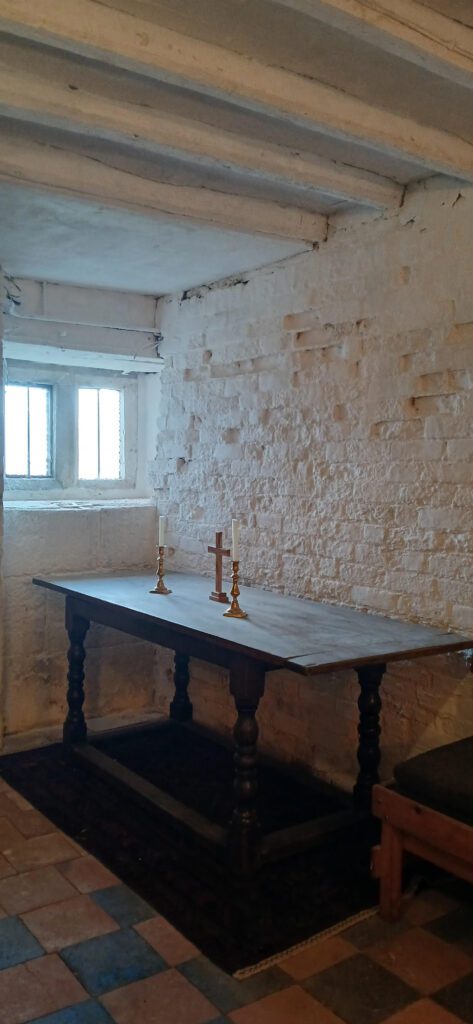
Prayer Room, Soulton Hall, Maundy Thursday, 2026
Central to this space is a wooden table, representing a profound departure from the fixed stone altars of earlier traditions. In the sixteenth century, this move toward a movable wooden surface signaled a significant change in the approach of the communities that would become known as Protestant, prioritizing the communal nature of a shared meal over the concept of a distant, sacrificial ritual. This table is positioned carefully to the side of the room, a placement that reflects a specific liturgical and spatial logic. It is situated in close proximity to the aedicule—a small, whitewashed chamber with a tiled floor that functions as a tabernacle or symbolic tomb. This layout suggests that the designers intended for the table and the aedicule to exist in a direct relationship to accommodate the events of Maundy Thursday, ensuring the transition from the communal fellowship of the meal to the solemnity of the vigil is both immediate and tangible.
Good Friday: The Solar Alignment of the Third Hour
On the day corresponding to the climax of the Passion narrative, the house shifts its focus from the domesticity of the basement to the vertical axis of the staircase, engaging a programmed sequence of Renaissance engineering designed to mark the third hour of the afternoon.
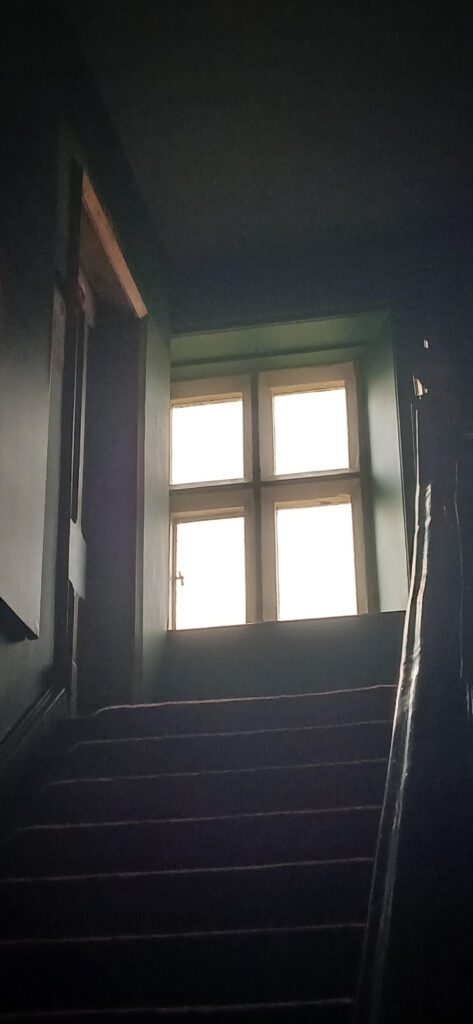
Good Friday Afternoon Light Effect iin First Gallery of Soulton Hall, 2026. Unfortunately a Cloudy day, so it is not as clear.
This architectural movement centers upon the gallery aperture, a unique window on the first gallery and the only one of its kind visible from the interior, which is precisely shaped as a cross. As the hour arrives, a halo of light appears behind this opening, allowing the building to project a beam through the staircase that casts a sharp, luminous image of a cross onto the floor below.
-

- It was cloudy for Good Frida y 2026 at Soulton, so here is the halo observation form 2024 for reference
-

- Cloudy skies in Shropshire dampened the 2024 projection effect this Good Friday. 2024 for refernce.
Functioning as a timed art installation, the light settles briefly before it begins a silent fade, quietly vanishing to mirror the transition of the scriptural story with a display of profound structural restraint.
The Aedicule and the Service of Tenebrae
The connection between these two spaces is physically shown through a shared internal window in the wall, which is important for the way matters are conducted in the Service of Tenebrae (there is no service of Tenebrae at Soutlon this year, but there have been in pervious years; click through to the record of the 2024 service).
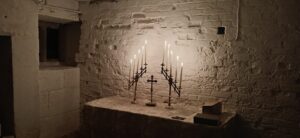
Image of Candelabras forming a Tenebrae hearse flanking a lantern for that observance from a previous observnce to 2026 to support the context of this blog.
In the office of Tenebrae, the final candle, which remains lit to represent the central figure of the narrative, is passed through this aperture from the prayer room into the aedicule.
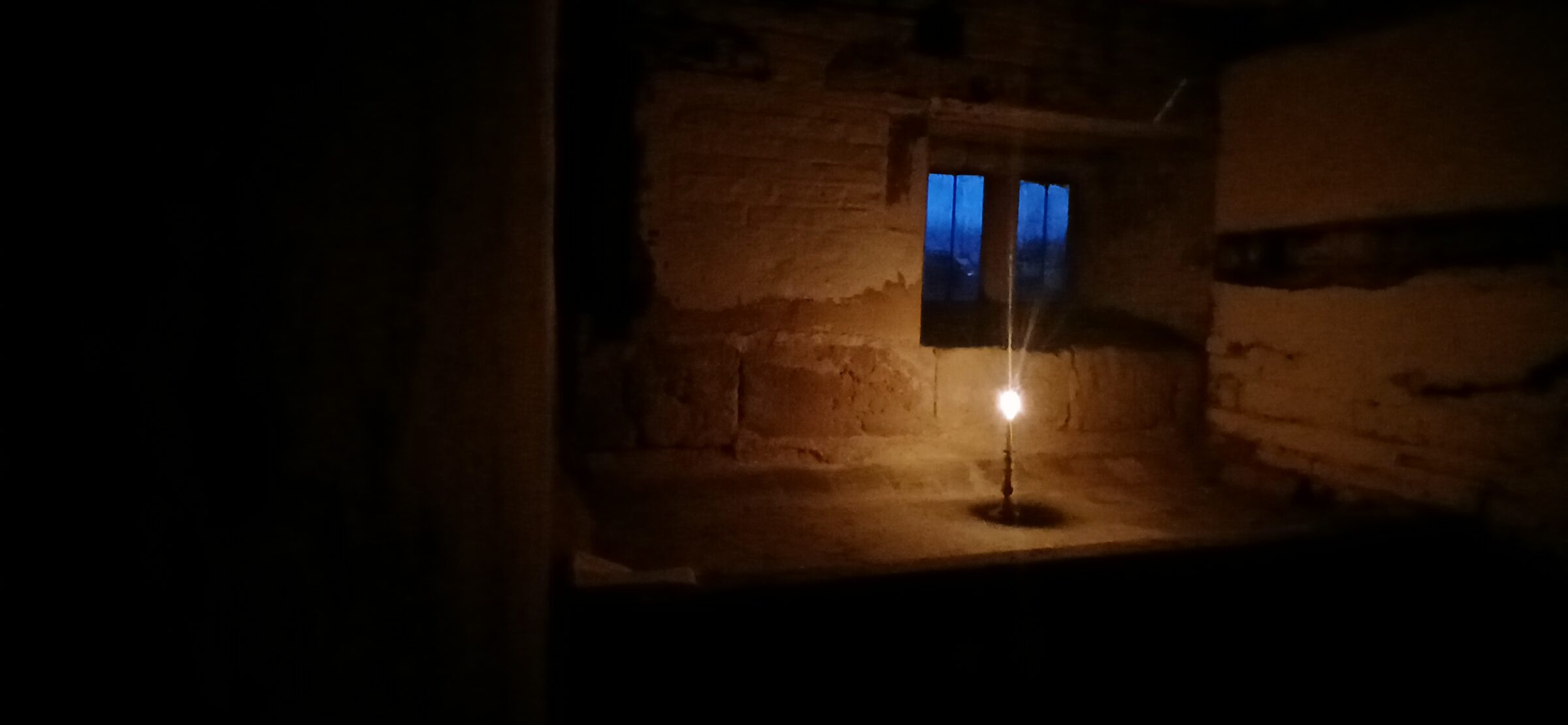
Placed within the Aedicule on the evening of Good Friday 2026, this Sole Candle acts as a piece of neoplatonic domestic liturgy, showing how the 16th-century house carries its ideas through stone. The “hidden light” is set deep within the chamber—which architecturally represents a tomb—to symbolize a presence that remains even when it is not visible to the world. As a visual metaphor for the Harrowing of Hell, this act uses the house to reflect on the story of light entering the deepest darkness.
This act moves the light from the domestic setting of the table into the simple, subterranean enclosure. Historically, evidence of sixteenth-century fittings indicates that the aedicule was then sealed entirely, plunging the whitewashed walls and tiled floor into total darkness. This enclosure creates a physical representation of the interval of the following day, holding the light in a state of quiet transition.
The Dawn Alignment
The final movement of the house is tied to its primary orientation, as Soulton Hall is precisely aligned to the sunrise of the spring festival.
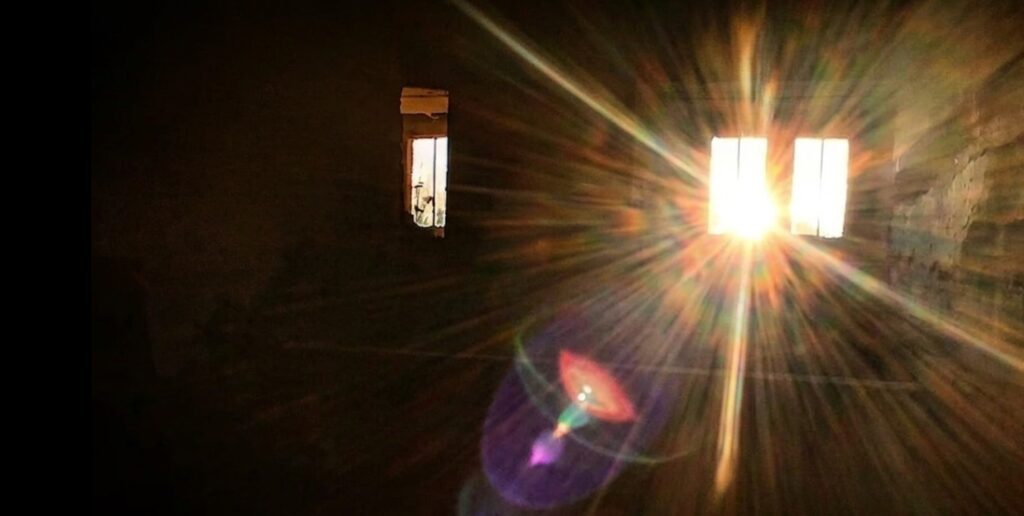
Easter Morning Sunrise, 2026, Aedicule, Soulton Hall
At dawn, the sun rises in direct alignment with the structure, and light enters the aedicule that was sealed in darkness the previous evening. In this moment, the building itself becomes an optical lens, moving the reflection from the basement prayer room and its wooden table to a cosmic level, where the rising sun provides a literal illumination of the symbolic tomb.
This archive provides a definitive record of these occurrences as they unfold in 2026.
By documenting these intersections of stone, wood, and solar time, we preserve the way the house carries itself—a practice of scholarship and structural narrative that has defined this place since the Renaissance.
Last updated, Good Friday, 2026
