


Happy St David’s Day from a part of England that sits in the sight of Wales—indeed on ground that carries a profound and ancient identity which is deeeply linked to Wales.
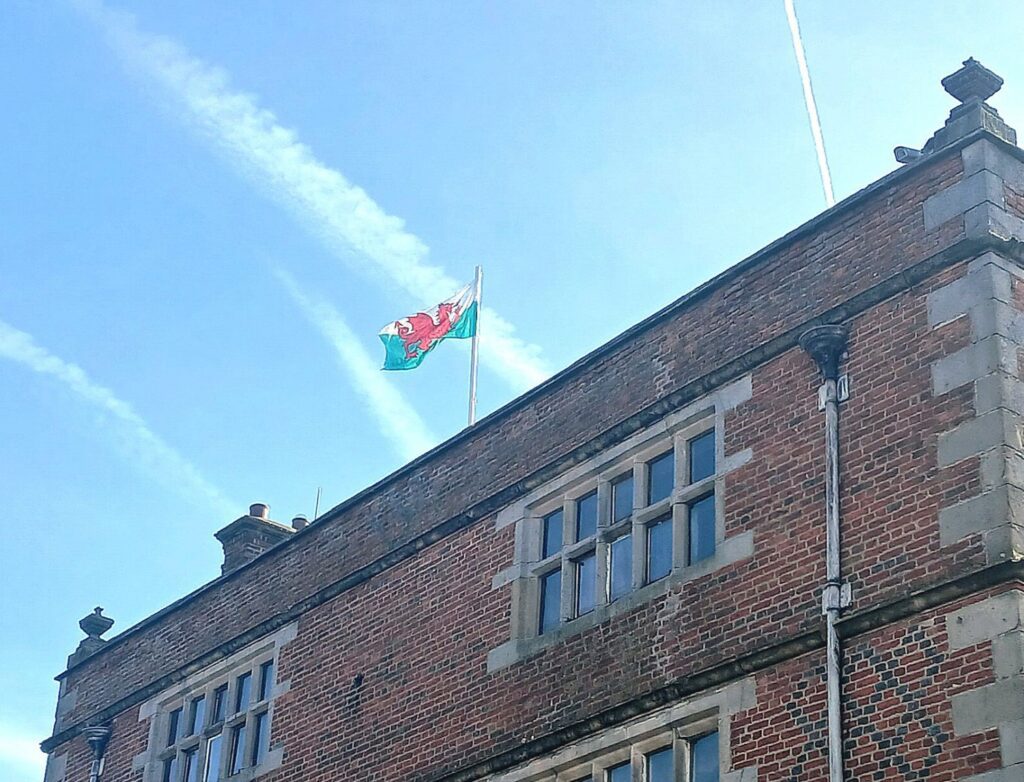
Welsh flag at Soulton on St David’s Day
This landscape was long ago a prized part of ancient Powys, celebrated in early Welsh poetry as the “Paradise of Wales.” It is a land of abundance and spiritual weight that the Tripartite Indenture of 1405 sought to restore to its ancestral roots. 621 years ago almost to the day, the ground beneath sought to be formally reclaimed for Wales; in the 15th century, Soulton was destined to be part of a Greater Wales under a vision of shared sovereignty.
We sit only a short distance from the ground of Maelor Saesneg (English Maelor), territory taken by the Welsh during the Anarchy of the 12th century. As we look out from the windows of Soulton Hall toward the Welsh hills, we are reminded of this fluid, shared history. The treaty signed on the eve of St David’s Day by Owain Glyndŵr, Edmund Mortimer, and Henry Percy was a radical plan to dismantle the English Crown. Under its terms, the border would have shifted significantly eastward to the “Ashes of Meigion” (Six Ashes), placing Soulton and the surrounding Shropshire landscape directly into a vast, independent Welsh Principality.
This sense of identity reaches even deeper than medieval politics, back to a unique spiritual tapestry where the ancient Celtic Christianity of the west was painstakingly melded into the Roman tradition. Figures like Erkenwald and St Chad navigated this delicate boundary, creating a synthesis of faith that still resonates in the quiet corners of our local parishes, grounding the Marches in a heritage that refuses to be neatly divided by a map.

Henry IV Part 1
While William Shakespeare’s Henry IV, Part 1 famously places Prince Hal in the taverns of London, the local reality was far more immediate. During the Glyndŵr rebellion, the future King Henry V was headquartered in Shrewsbury; these fields were his training ground, and the Battle of Shrewsbury in 1403 was a terrifying lived reality for the families of the Marches.
It is no coincidence that the Wars of the Roses are so heavily focused on these Shropshire borders. Throughout the History Play cycle, the Marches serve as a stage for a grim warning about the consequences of political division and going too far with the constitution. Shakespeare captures this through the Bishop of Carlisle’s warning in Richard II. It is a prophecy of the generational trauma that follows when the fundamental order of the land is broken:
And if you crown him, let me prophesy:
The blood of English shall manure the ground,
And future ages groan for this foul act;
Peace shall go sleep with Turks and infidels,
And in this seat of peace tumultuous wars
Shall kin with kin and kind with kind confound.
For the people of Soulton and the surrounding counties, this wasn’t just theater—it was a warning of the “manure” of war, the generations of trauma, and the agonizing challenges of reconciliation that follow political excess.
Yet, as the “Tudor Peace” eventually took hold, this history of conflict was transformed into a Renaissance of thought and a cousinhood of buildings that emerged across both sides of the border: Soulton Hall served as the architectural prototype for Bach-y-Graig in Denbighshire.

Bach y Graig, captured in the C18th
Built by the visionary Sir Richard Clough, Bach-y-Graig was a direct “cousin” to Soulton, emulating its encoded design and anchoring a shared intellectual world.
This connection is centered on the years 1560 and 1567—the date found on the plates at Bach-y-Graig and the very year the New Testament was first published in the Welsh language. Soulton stands as a monument to the work of the Geneva Bible, which brought the scriptures in English thought to the masses.

Scholarly reconstruction of Soulton Hall in 1560 created Byrga Geniht Ltd
This was a fraught and dangerous moment in history; prior to the Welsh Bible, the Geneva project was considered treasonous and heretical in its time. The existence of a Bible in the vernacular was a matter of intense struggle, yet it was championed by the humanist circles to which these families belonged and was vital for the preservation of Welsh culture.
You can meditate on this hard-won harmony through the lens of Shakespeare’s most enigmatic poem, “The Phoenix and the Turtle.”
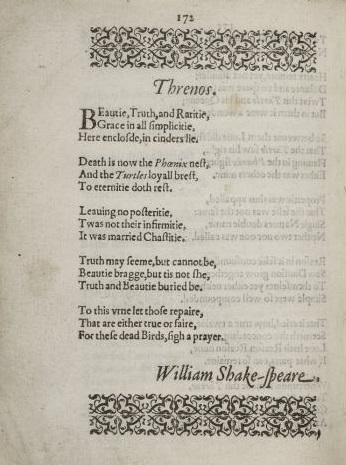
Shakespeare’s name at the closing of the poem, “The Phoenix and the Turtle,”
In the symbolic language of the era, the poem speaks of a “True Concord” and a mystical union where “Distance and no space was seen.” It reflects, we think, on the profound affection and the intellectual effort required to recognize the distinct identities of England and Wales while existing within a single, harmonious whole—the “single nature’s double name.”
This era of intellectual flowering was cemented by family alliances, such as the 1573 marriage of Elizabeth Corbet (daughter of Sir Reginald Corbet) to Robert Arden. This union linked our local ancestors directly to the family of Mary Arden, Shakespeare’s mother, reminding us that the “Cycle of History” was a personal story for the people of this county.
On this St David’s Day, we recognize that shared heritage—the “Paradise” of Powys, the memory of the 1405 conflict, and the enduring peace that allowed the Renaissance to bloom in the soil and stones of the Marches.
