

In recent months, Soulton Hall has been engaged in a series of quiet, purposeful conversations with stakeholders at Walsingham and Holywell and beyond.
These dialogues have been entered into modestly, seeking to learn from places that have, for centuries, carried the weight of national memory and spiritual attendance.
To understand these conversations, one must understand what these sites represent.
-
Walsingham has long been considered by faith communities “England’s Nazareth,” a focal point for the soul of the nation that survived through periods of total iconoclasm.
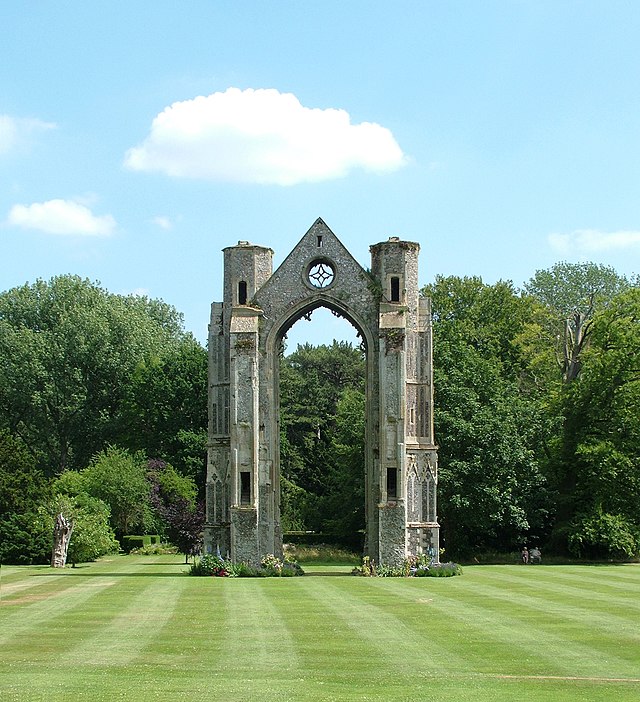
Walsingham Abbey
-
Holywell (St Winefride’s Well) represents for many an unbroken thread of pilgrimage—a “Lourdes of Wales” that persisted even when the world around it was fracturing.

Winifred’s Well: the roof above the well – early C16th work
These are not merely tourist sites; they are vessels of continuity that prfoundly matter to a lot of people.
In speaking with their custodians, we have been seeking a shared language for what Soulton Hall represents here in the Shropshire landscape. In applying these lessons, we recognize our role as a secular estate with a memory of significant consequence. The history of this land is defined by bifurcated stories; during a period of intense national suffering and persecution—a trauma felt across more than one dispensation—Soulton was a place where those stories were protected from the wider storm. It acted as a steadying ground, curated by people of good will who, though adjacent to faith communities, provided the safety and space needed for a shared heritage to endure.
Because Soulton was shielding people and things from the worst of the historical destructions that claimed so much of our shared heritage, we find ourselves as the unexpected custodians of a survival story. This realization brings with it a profound, quiet duty. We recognize that we are not the protagonists of these faith stories, nor are we leading a faith community; the spiritual expression of this heritage is a matter for those communities themselves. Our role is as the guardians of the ground upon which these stories unfolded.
In our dialogues, it has been suggested that the work of historical thinkers like St. Irenaeus of Lyon provides helpful insight. Recently recognized as a “Doctor of Unity,” Irenaeus’s ancient perspectives offer a framework for understanding the importance of wholeness. In his own time, he resisted the impulse to fragment the human story or to treat history as a secret possession of a select few. By maintaining Soulton as a transparent and shared heritage environment, we seek to honor that spirit of unity—ensuring that history is not hoarded or divided, but held in common trust for the whole community.
For a secular estate, this context demands a role of responsible custodianship. It requires us to be welcoming to those for whom this history is living, while remaining mindful of our role as a neutral space. We see our task as maintaining this place of safekeeping—ensuring that the memory of those who resisted the traumas of the past is handled with care.
Finally, we wish to express our sincere gratitude to the many people who have helped shape these insights. We have been moved by the depth of sharing across faith communities, and within families and institutional contexts that are secular in nature but share in this profound experience of history. We approach this ongoing dialogue with a sense of service, aware that the “sheltered” nature of this place is a gift we hold in trust for the wider community.
End Note
In contemplating our place alongside such historic sites, we have come to recognize that Soulton Hall is maybe best viewed as carrying a slightly distinct, and perhaps quieter, vocation. While places like Walsingham serve as “England’s Nazareth”—a prophetic, symbolic recreation of a holy house—Soulton has functioned more as an Ark. During the height of the Reformation’s storm, the intent here was clearly to remember the old world, but apparently to physically save its core material culture. If, as the evidence suggests, Soulton became the repository for the High Altar stone of Old St Paul’s and the relics of St Erkenwald, then this house is more than a Tudor manor. It is a piece of London in exile.
In the Tudor imagination, London was Troynovant (the New Troy); seen in this light, Sir Rowland Hill’s actions mirror those of a Tudor Aeneas, bringing the heart-stones of the capital to the safety of the Shropshire mud. There is room here for many interpretations of his intent. It may have been a high-minded preservation of the nation’s soul as he saw it, but it could equally have been something more transactional—a form of cultural insurance during a volatile century. By sheltering these objects, Hill was, whatever hs motivations, ensuring that whatever the future held, the memory and the physical link to the past remained available.
This perspective also engages with how one might see Shakespeare’s As You Like It: the Forest of Arden (which includes Shropshire) is a place of temporary exile—a “Golden World” preserved in amber where Duke Senior waits for the discord of the world and the court of Duke Frederick to pass. Seen this way, Soulton is that theatre of living memory—not as a site of a single dogma, but as an enclave curated by people of good will who provided a secular shelter for consequential things until the next steps for the nation could be considered safely.
Guarding the ground upon which the ancient city maintained its physical footprint when the Cathedrals were being stripped remains a quiet duty. This is why the presence of London representation at our ecumenical services on St Erkenwald’s feast day is so significant; it represents a reconnection with things needfully hidden now being shared again. By bringing the Protestant banner applied to Sir Rowland Hill together with the ancient Anglo-Saxon roots of the “Light of London”, we find a Common Wealth. Soulton can best serve where it remains a neutral, sheltered ground—a secular estate holding a venerable memory across time—offering a place of reconciliation where the story that started as a common story eventually meets the Common Roots of that shared history.
Update: 27 February 2026 We were pleased to speak yesterday with the Anglican National Shrine as part of our ongoing process of discernment. These dialogues remain central to our role as custodians of this landscape, and we look forward to making a visit to Walsingham in the near future to strengthen these connections.
