


Today’s BBC Radio 4 In Our Time—focusing on Henry IV, Part 1—brings a familiar local resonance to the airwaves.
Misha Glenny is joined by Anouska Lester, Jonathan Bate, and Emma Smith to discuss one of the most successful of Shakespeare’s plays in his own time.

Shakespeare
While the scholars discuss the “greatness” of the play, we are reminded that this is not just a masterpiece of English literature; it is a Shropshire epic.
The play’s movement toward our landscape is defined by the King’s own strategic command at the end of Act III:
On Wednesday next, Harry, you shall set forward;
On Thursday we ourselves will march: our meeting
Is Bridgenorth: and, Harry, you shall march
Through Gloucestershire; by which account,
Our business valued, some twelve days hence
Our general forces at Bridgenorth shall meet.
Our hands are full of business: let’s away;
Advantage feeds him fat, while men delay.
This is no poetic abstraction. It is a strategic, mud-on-the-boots reality: Bridgnorth was the pivot point of the Severn, the bottleneck that allowed the King’s forces to consolidate before the decisive clash at the Battle of Shrewsbury.

Hotspur in a stained glass window at Berwick House
The broadcast touches on the Sir John Oldcastle controversy. A prominent Lollard leader and follower of the Oxford theologian John Wycliffe, Oldcastle was a key figure in the 14th-to-16th-century English religious reform movement. Often considered a precursor to the Protestant Reformation and immortalized as a proto-Protestant hero (therefore of interst to the legacy of Old Sir Rowland Hill) in Foxe’s Book of Martyrs, he was the original namesake for Falstaff. Shakespeare was famously forced to “code” the name change to Falstaff to avoid political reprisal from Oldcastle’s powerful descendants, the Lords Cobham.
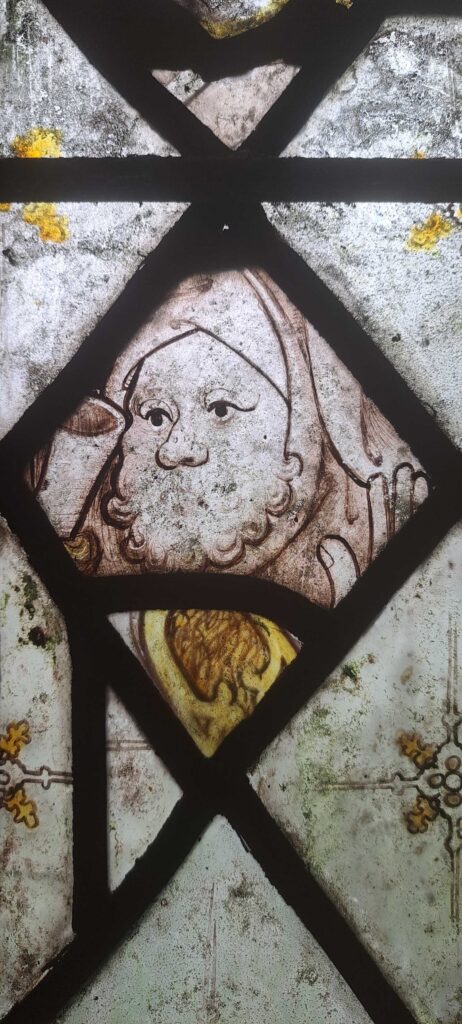
Lovely bearded, fat figure from the Battle of Shrewsbury Window now in Prees said to be Falstaff.
It is often said that Henry IV is the “Shropshire Shakespeare play,” but the truth is that many of his works have roots right here in this county. The legacy of Sir Rowland Hill breathes through the “Sir Rowland de Boys” of As You Like It; Elizabeth Vernon links the region to Romeo and Juliet via Hodnet; the arrest of Buckingham in Richard III and the Princes in the Tower at Ludlow are central to the Lancastrian and Yorkist sagas.
 Shakespeare wasn’t just visiting Shropshire in his mind; he was writing from the perspective of a family deeply embedded in its soil. The Arden family of his mother were Lords of the Arden territory in Saxon times, and that ancient forest territory included Wem, where they were the pre-1066 lords.
