

Standing in the Hall Hall of Soulton Hall, your eyes are immediately drawn to a heavy oak seat: the Chair of Estate belonging to “Old” Sir Rowland Hill. It is a piece of furniture that breathes the atmosphere of the Tudor court, but it is the modern addition nearby that truly decodes the room’s history.

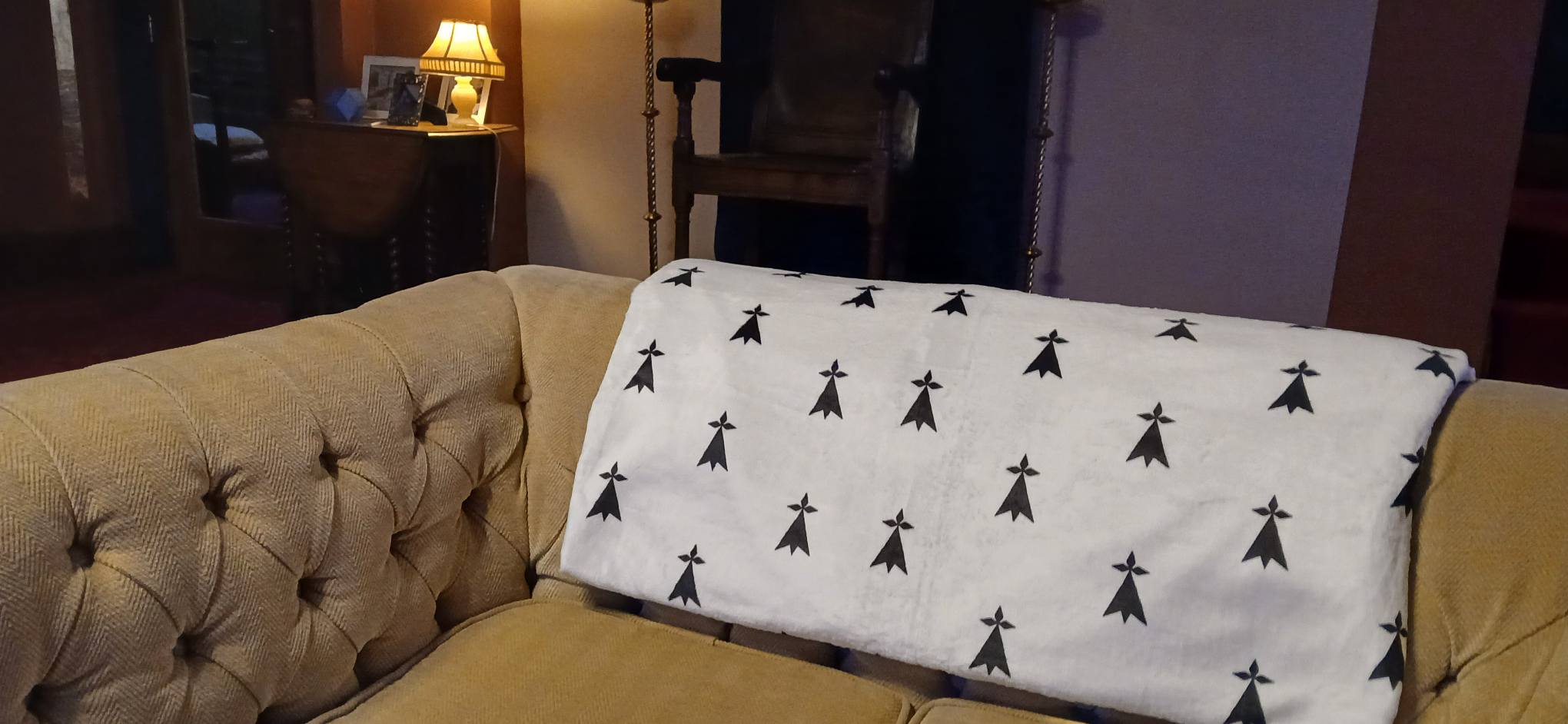
Ermine Throw
Draped across the furniture are modern ermine-patterned throws.
While the fabric is new, the intent is ancient.
These throws are a deliberate visual recovery of a Renaissance language that once defined the moral landscape of England.
The Shift in the Shield: From Towers to Truth
To understand the ermine, one must look at the evolution of the Hill family heraldry. Originally, the Hill arms were stoic and defensive: a castle of three towers on a black field. It spoke of strength, fortification, and the physical security of the family’s holdings, and perhaps more…

Portrait of Sir Rowland Hill, Mercer’s Copy
However, Sir Rowland Hill—a man who navigated the treacherous politics of four Tudor monarchs—augmented these arms with the ermine. This wasn’t a mere fashion choice; it was a profound shift in messaging. In the Renaissance mind, the ermine was the ultimate symbol of virtue and unsoilable integrity.
Legend held that the ermine would rather face death at the hands of hunters than soil its snow-white coat in the mud. By placing this “white mantle” over the black field of his ancestral towers, Sir Rowland was declaring his personal code: Malo Mori Quam Foedari—Death before Dishonor.
A Faith Shrouded, A Virtue Certain
While much is made of the religious upheavals of the 1500s, Sir Rowland’s personal “Protestantism” remains a thing of tactical ambiguity. He was a man of the “middle way,” a “Prince of Merchants” who funded the printing of Bibles while holding high office under both Catholic and Protestant rulers. His specific theology is a cipher, much like the coded architecture of Soulton Hall itself.
But while his faith was private, his virtue was absolute. In an age of shifting allegiances and state-sanctioned betrayals, Sir Rowland was the anchor of a “Rebel Alliance”—a network of thinkers, scholars, and dissenters who sought truth over tyranny. Ermine was their flag; it signaled that within this sphere, honor was the highest currency.
The Legacy of the Female Line
The sheer weight of Sir Rowland’s character is proven by what happened after his death. Typically, heraldry follows a strict patrilineal path, but because of the immense importance of his legacy, his arms—and the ermine within them—continued through the rights of the female lines more than once.
Families fought to retain the Hill arms because they weren’t just claiming a name; they were claiming a standard of conduct. They were tethering themselves to the man who stood as a pillar of integrity during the “Great Matter” of the English Reformation.
Recovering the Language
Today, the presence of the ermine-patterned throws in the Hall serves to “re-tune” our modern eyes. We have largely lost the ability to read the symbolic shorthand of the Renaissance, but by reintroducing this pattern to the room where Sir Rowland’s chair sits, the Hall restores the atmosphere of his era.
The throws remind the visitor that:
- The Hall is a Sanctuary: Just as the ermine avoids the mud, Soulton was built to be a place where virtue could remain “unsoiled” by the persecutions of the outside world.
- The Code is Living: The use of modern fabric to represent an ancient heraldic charge shows that the “Rebel Alliance” is not a dead chapter of history, but an ongoing commitment to conscience.
- Integrity is the Armor: The castle towers remain, but they are now draped in the white of the ermine, suggesting that the strongest fortification a person has is their honour.
When you look at the black-on-white pattern today, remember that you are looking at more than a design. You are looking at the “White Mantle” of a rebel who believed that some things—like a clean soul—are worth more than life itself.
